The Truth About Housing Market Investors: Why Big Corporations Aren’t Buying All the Homes

If you’ve been following the housing market lately, you’ve probably heard the same story repeated again and again: investors are buying all the homes, leaving everyday buyers with fewer opportunities.
Headlines often paint a dramatic picture—huge corporations swooping in, purchasing properties in bulk, and pushing regular homebuyers out of the market. If you're trying to buy a house yourself, that narrative can feel discouraging. It may even seem like the game is rigged before you step onto the field.
But here’s the interesting part: when you actually look at the data, the story changes completely.
The truth is far more nuanced—and surprisingly reassuring for everyday buyers. Let’s break down what’s really happening in today’s housing market and why investors may not be the dominant force many people think they are.
The Investor Myth in Today’s Housing Market
When most people hear the word investor, a very specific image comes to mind.
You probably picture large corporations, hedge funds, or Wall Street firms purchasing entire neighborhoods of homes. It's easy to imagine these powerful companies with deep pockets outbidding regular buyers every time.
But that perception is largely shaped by headlines—not by reality.
In truth, the majority of housing market investors are not massive corporations. Instead, they’re ordinary individuals who happen to own additional properties.
Think about it this way: if someone owns a second home or rents out a property they previously lived in, technically, they’re considered an investor. That definition covers a lot more people than most of us realize.
And once all these different types of owners get grouped together in housing data, the term investor suddenly sounds much bigger and more intimidating than it actually is.
Most Real Estate Investors Are Everyday People
Let’s take a closer look at who these so-called investors really are.
In many cases, they’re just regular homeowners making practical financial decisions.
For example, an investor could be:
- A family that owns a vacation home near a lake or beach
- A neighbor who purchased one or two rental properties
- A homeowner who couldn’t sell their property at the desired price and decided to rent it out instead
- Someone saving for retirement by holding onto an extra home as a long-term asset
None of these scenarios involve massive corporate strategies or billion-dollar funds. They’re simply people managing their personal finances.
It’s a bit like calling someone with a small vegetable garden a commercial farmer. Technically, both grow food—but the scale is completely different.
When reports lump these small-scale property owners together with large institutional investors, the numbers can look misleadingly large.
And that misunderstanding fuels the belief that investors are taking over the housing market.
Institutional Investors Control Only a Tiny Share
Now let’s talk about the investors most people are actually worried about: large institutional buyers.
These are the companies that own hundreds or even thousands of homes across multiple markets. They’re often the ones mentioned in news stories about corporate ownership of residential properties.
However, the data reveals something surprising.
Large institutional investors—those owning 1,000 or more homes—represent only a very small fraction of the housing market.
Out of approximately 86 million single-family homes in the United States, the biggest institutional investors own only about 0.4% of them.
Think about that for a second.
If the housing market were a pizza with 100 slices, institutional investors would control less than half of one slice.
That’s a far cry from the idea that corporations are dominating the market.
Big Investors Are Actually Selling More Homes
Here’s where the story becomes even more interesting.
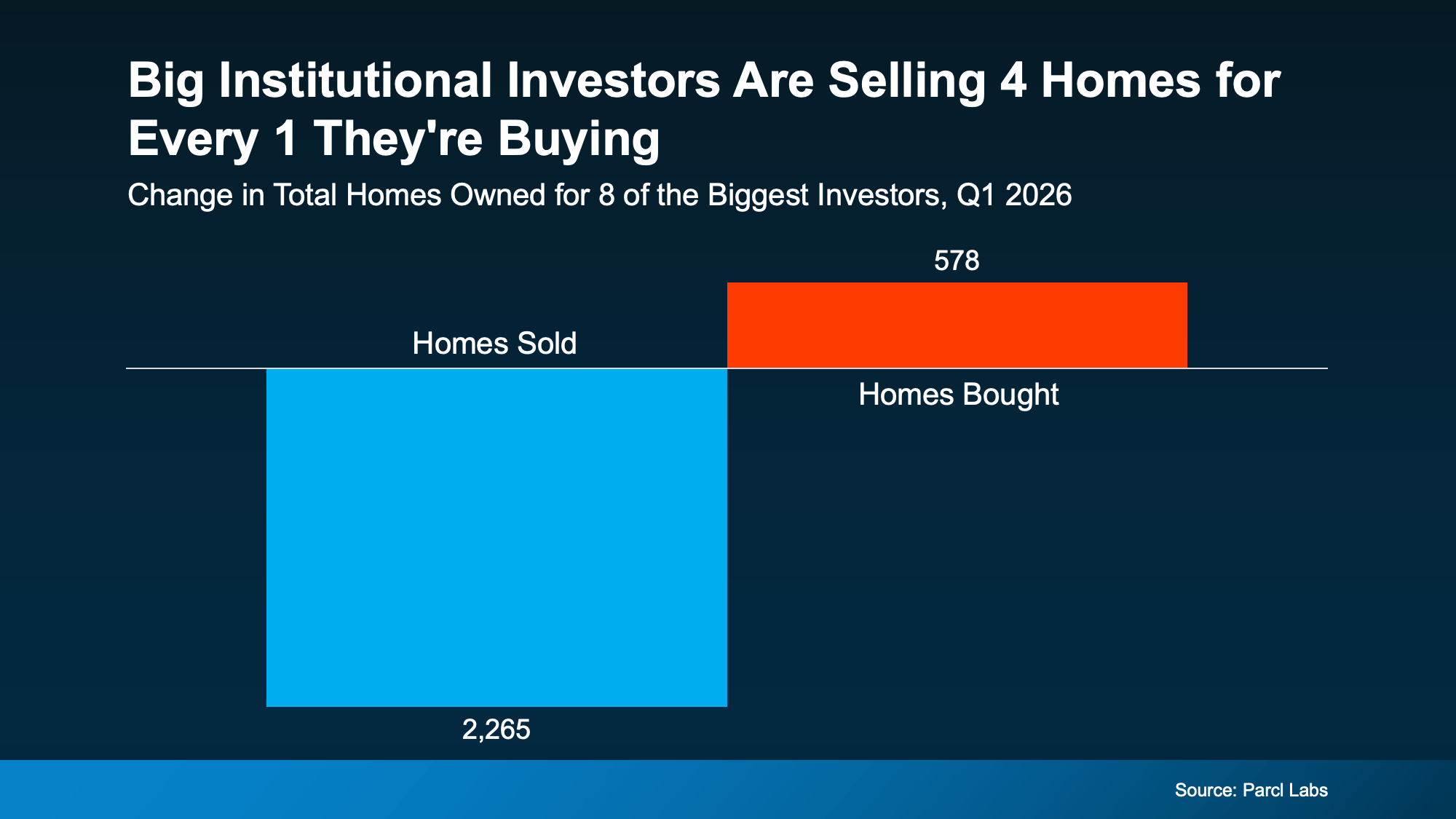
Not only do institutional investors own a small portion of homes—but many of them are currently selling properties rather than buying more.
Recent market data shows that large investors are selling roughly four homes for every one home they purchase.
In other words, they’re reducing their holdings instead of expanding them.
That shift has quietly returned thousands of homes back to the open market, increasing inventory for potential buyers.
And that matters because one of the biggest challenges in recent years has been the lack of available housing supply.
When large investors sell properties, those homes often become available for regular buyers, which can ease competition and provide more opportunities.
Why Investor Activity Is Slowing Down
So why are institutional investors pulling back?
There are several reasons behind this shift.
First, higher interest rates have changed the economics of buying homes as investments. Borrowing money to purchase properties is more expensive today than it was a few years ago.
Second, home prices have risen significantly in many areas. While that’s great news for homeowners building equity, it also means investors must spend more upfront to acquire properties.
And finally, rental market dynamics are evolving. In some areas, rent growth has slowed, making new purchases less attractive compared to other investment options.
When these factors combine, large investors often choose to slow down their acquisitions—or even sell off some properties.
For everyday homebuyers, that shift can open doors that previously felt closed.
What This Means for Homebuyers
If you’re planning to buy a home, the takeaway is simple: corporate investors may not be the competition you need to worry about most.
In reality, the buyers you’re most likely to compete with are people just like you.
They might be:
- First-time buyers searching for their first home
- Families looking to upgrade to a larger space
- Individuals relocating for work or lifestyle changes
In other words, the housing market is still largely driven by regular people making life decisions, not massive investment firms controlling everything behind the scenes.
And with many institutional investors stepping back from aggressive purchasing, buyers may encounter less corporate competition than expected.
The Role of Supply in the Housing Market
Of course, investors aren’t the only factor influencing the housing market.
One of the biggest drivers of home prices and competition remains housing supply.
For years, many regions have experienced a shortage of available homes. When supply is limited and demand remains strong, competition naturally increases.
But as more homes enter the market—whether through new construction or investor sales—buyers gain more options.
That shift can help balance the market over time.
Think of it like a crowded restaurant. When there are only a few tables available, everyone competes to sit down. But when more seats open up, the pressure disappears.
The same principle applies to housing inventory.
Why Headlines Can Be Misleading
So why does the narrative about investors buying everything persist?
Part of the answer lies in how information spreads.
Eye-catching headlines often highlight extreme examples because they generate more attention. A story about a corporation buying hundreds of homes in a single neighborhood makes for dramatic reading.
But isolated examples don’t always reflect broader trends.
When you zoom out and examine nationwide data, the picture looks very different.
Instead of corporate domination, the housing market is still largely shaped by millions of individual buyers and small property owners.
Understanding the Market Before You Buy
If you're thinking about buying a home, it's important to base your decisions on data, not just headlines.
Real estate markets are complex. They change depending on location, inventory levels, economic conditions, and buyer demand.
What’s happening nationally might not perfectly reflect what’s happening in your local market.
That’s why speaking with a knowledgeable real estate professional can help you understand the specific conditions in your area—whether investors are active there, how competitive the market is, and what opportunities may exist.
Having the right information can make the homebuying process feel far less intimidating.
Bottom Line: Investors Aren’t Taking Over the Housing Market
Despite what many headlines suggest, the data tells a very different story.
Most real estate investors are everyday people, not large corporations. Meanwhile, institutional investors own only a tiny fraction of homes and are currently selling more properties than they’re buying.
For homebuyers, that means the market may be more accessible than it seems at first glance.
So if you’ve been worried that giant companies are buying every home before you even get a chance—take a breath.
The housing market is still largely driven by people just like you.
And with the right strategy, patience, and guidance, your opportunity to find the right home may be closer than you think.
Recent Posts









GET MORE INFORMATION