Are Big Investors Really Buying Up All the Homes? The Real Truth Behind the Headlines

If you’ve spent even five minutes scrolling through social media or skimming housing news lately, you’ve probably seen it:
“Big investors are buying up all the homes.”
It’s repeated so often that it starts to feel like an undisputed fact. And if you’re a buyer who’s lost multiple offers, watched prices climb, or felt squeezed out of the market, that narrative can feel painfully real. After all, when competition is fierce and homes are expensive, it’s easy to imagine massive corporations quietly snapping up properties while everyday buyers are left empty-handed.
But here’s the uncomfortable truth most viral posts won’t tell you: what people believe is happening and what the data actually shows are not the same thing.
Let’s pull back the curtain, look past the headlines, and break down what’s really happening with large institutional investors in today’s housing market. Spoiler alert: the numbers tell a much calmer, more nuanced story.
The Stat That Rarely Goes Viral (But Should)
Let’s start with the single most important data point—one you almost never see shared online.
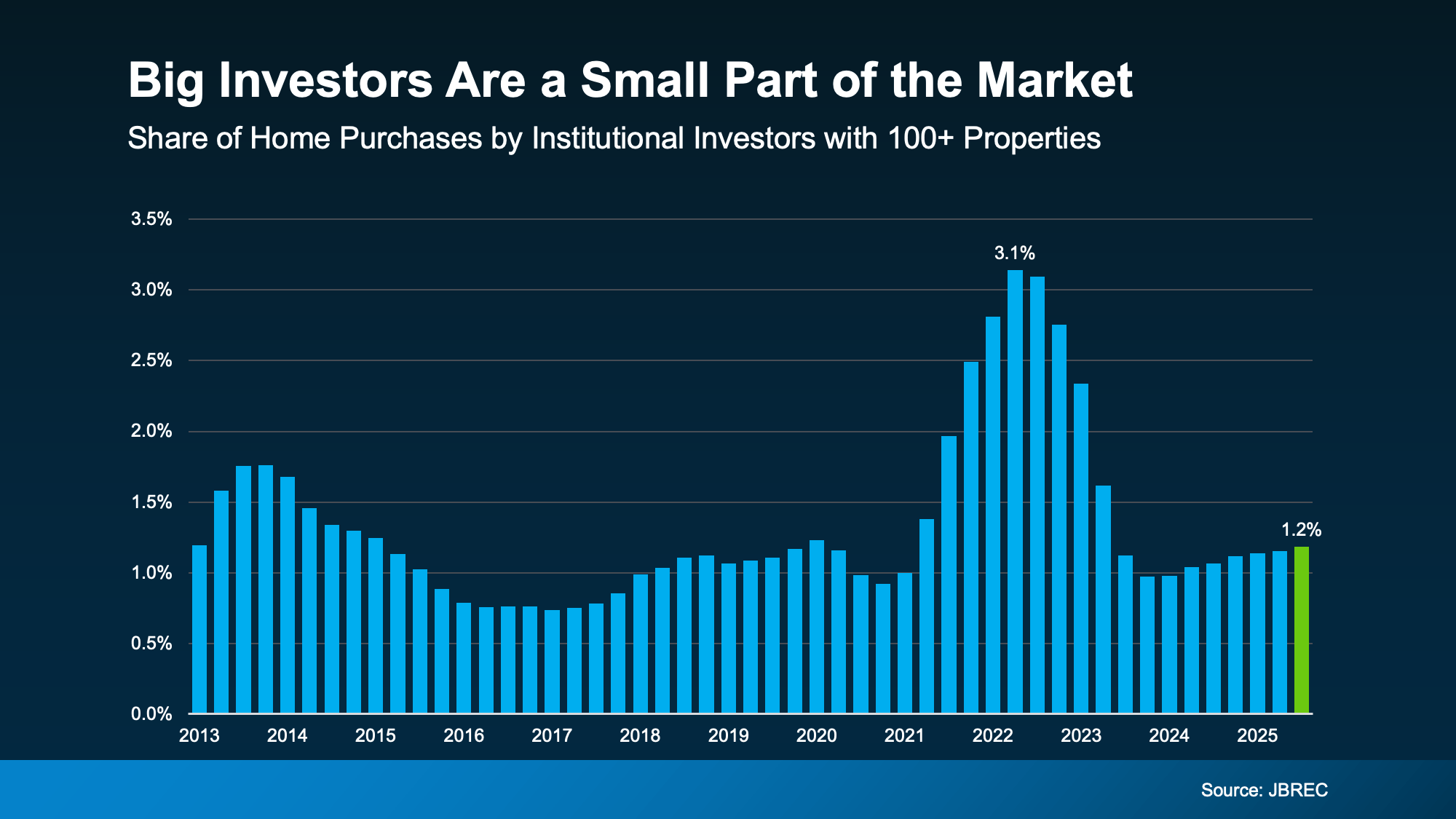
According to John Burns Research & Consulting (JBREC), large institutional investors—defined as those owning 100 or more homes—accounted for just 1.2% of all home purchases in Q3 of 2025.
Read that again.
Out of every 100 homes sold nationwide, only about one went to a large institutional investor.
That’s not domination. That’s barely a blip.
Even more interesting? This level of investor activity isn’t unusual at all. It’s well within historical norms and significantly lower than the recent peak of 3.1% in 2022—a period when investor buying was already considered elevated.
So while it may feel like big investors are everywhere, nationally speaking, they are responsible for a very small fraction of total home sales.
Why It Feels Like Investors Are Everywhere
If the data shows such a small share, why does this narrative have so much traction? Why does it feel so real to so many buyers?
There are two major reasons—and both matter.
Investor Activity Isn’t Evenly Distributed
First, investor activity isn’t spread evenly across the country.
Think of it like rain. Nationally, the forecast might say “light showers,” but locally, you could be standing in a downpour. Some housing markets see far more investor presence than others, which can make competition feel intense—especially for entry-level homes.
As Lance Lambert, Co-Founder of ResiClub, explains:
“On a national level, ‘large investors’—those owning at least 100 single-family homes—only own around 1% of total single-family housing stock. That said, in a handful of regional housing markets, institutional and large single-family landlords have a much larger presence.”
In other words, if you live in one of those concentrated markets, your experience may feel very different from the national average. That doesn’t mean the national data is wrong—it means housing is deeply local.
“Investor” Is a Catch-All Term (And That’s Misleading)
The second reason this issue gets so much attention? The word “investor” is doing way too much work.
Most headlines lump all investors into one category, combining:
-
Large Wall Street-backed institutions
-
Regional investment groups
-
Small local landlords
-
Individual buyers who own one or two rental properties
That’s like grouping mom-and-pop shops with Amazon and calling them all the same thing.
In reality, the vast majority of investors are small, local owners, not massive corporations. These are people who might own one rental home, a duplex, or a couple of properties as part of their retirement plan.
When headlines say, “Investors bought X% of homes,” they’re usually talking about all investors combined—not just big institutions. That inflated number then gets interpreted as “Wall Street is buying everything,” even though the data doesn’t support that conclusion.
Yes, Big Investors Exist—But Context Is Everything
Let’s be clear: large institutional investors are real. They do buy homes. They are active in certain markets.
But nationally?
They represent a tiny slice of total purchases—far smaller than most people assume.
The idea that giant corporations are single-handedly driving up prices or locking everyday buyers out of homeownership simply doesn’t hold up when you look at the numbers.
So if big investors aren’t the main culprit, what is?
The Real Drivers of Housing Affordability
Here’s where the conversation needs to shift.
The biggest challenges facing buyers today have far more to do with supply and demand than with institutional investors.
Years of Underbuilding
For over a decade after the Great Recession, the U.S. underbuilt housing. Builders produced fewer homes than the growing population needed, creating a long-term shortage that we’re still dealing with today.
You can’t fix a decade-long supply problem overnight.
High Demand Meets Limited Inventory
Even as mortgage rates fluctuate, demand for housing remains strong—especially in desirable job markets and lifestyle-driven cities. When too many buyers chase too few homes, prices rise. That’s basic economics.
Lock-In Effect
Many homeowners with ultra-low mortgage rates from previous years are reluctant to sell. This keeps resale inventory tight and limits options for new buyers entering the market.
Together, these factors do far more to impact affordability than institutional investors ever could.
Headlines vs. Reality: Why Fear Spreads Faster Than Facts
Let’s be honest—fear gets clicks.
A headline that says “Big Investors Are Buying Everything” spreads faster than one that says “Institutional Investors Represent 1.2% of Purchases.” One sparks outrage. The other requires nuance.
But making major financial decisions—like buying or selling a home—based on viral narratives instead of real data can be costly.
That’s why separating noise from reality matters, especially if you’re trying to decide whether now is the right time to move.
What This Means for Buyers Right Now
If you’re a buyer feeling discouraged, here’s the takeaway:
-
You’re not competing against Wall Street on every offer
-
Big investors are not dominating the national housing market
-
Local conditions matter far more than national headlines
Understanding what’s actually happening in your specific market is far more valuable than reacting to generalized social media claims.
Why Local Context Changes Everything
Real estate is hyper-local. Investor activity, inventory levels, pricing trends, and competition can vary dramatically from one city—or even one neighborhood—to the next.
That’s why two buyers in different markets can have completely different experiences, even in the same year.
Context is the difference between feeling overwhelmed and feeling informed.
Bottom Line: Facts Beat Fear Every Time
Big investors make headlines, but they don’t make up the bulk of the market.
Nationally, large institutional investors account for around 1% of home purchases, a level that’s consistent with historical norms and far from market domination. The real challenges around affordability stem from long-term supply issues, strong demand, and years of underbuilding—not from corporations buying every available home.
If you want to understand what investor activity actually looks like in your local market, and how it does—or doesn’t—affect your buying or selling options, let’s talk.
Sometimes, a little clarity is all it takes to turn uncertainty into confidence.
Recent Posts








GET MORE INFORMATION