Why Downsizing Is Becoming the Smart Retirement Move for Today’s Homeowners

by Conor J. Green

For many homeowners, retirement used to feel like a far-off milestone—something to think about someday. Now? That “someday” is knocking at the door.

Every single day, nearly 12,000 Americans turn 65, and that pace isn’t slowing down anytime soon. In fact, a growing share of older homeowners are planning to retire in the next couple of years, with a significant number eyeing 2026 and 2027 as their transition window. And as that reality sets in, one question keeps coming up:

Does my current home still fit the life I’m about to live?

For many, the honest answer is no. That’s why downsizing has quietly become one of the biggest lifestyle shifts among homeowners today—not as a sacrifice, but as a strategic, empowering move toward a simpler and more intentional future.

Let’s break down why downsizing is gaining momentum, what’s driving the decision, and why it may be more achievable than you think.

Retirement Changes Everything—Especially How Your Home Should Work for You

Retirement isn’t just about leaving a job behind. It’s about redesigning your daily life.

The routines shift. The priorities change. The way you use your home evolves. Suddenly, the house that once made perfect sense—extra bedrooms, stairs, long commutes, high maintenance—can start to feel like more work than reward.

And here’s the key point many people miss: downsizing doesn’t mean living with less.
It means living lighter.

Most retirees aren’t chasing luxury or square footage anymore. They’re chasing ease. Comfort. Flexibility. Peace of mind.

Think of it like this: your home should support your life, not slow it down.

Why Downsizing Feels So Appealing Right Now

At its core, downsizing is about alignment—matching your home to the season of life you’re entering.

Many homeowners describe the motivation in similar terms:

  • Easier to enjoy everyday life

  • Easier to manage and maintain

  • Easier to move through, both physically and financially

When you remove unnecessary space, upkeep, and expenses, what’s left is breathing room—both literal and mental.

And this shift isn’t theoretical. The data backs it up.

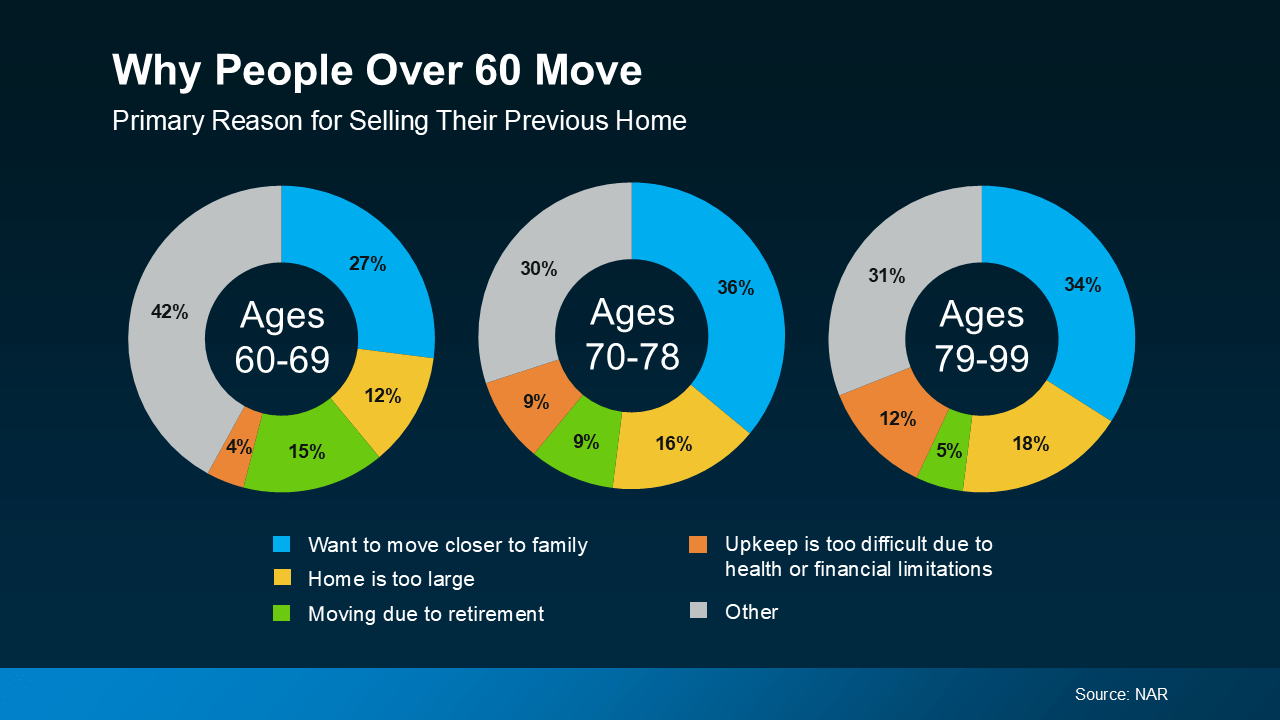
The Top Reasons Homeowners Over 60 Are Choosing to Move

When homeowners over 60 decide to relocate, it’s rarely about trying to time the market or squeeze out every last dollar. According to housing data and industry research, the reasons are overwhelmingly lifestyle-driven.

Here are the most common motivations behind downsizing decisions:

1. Being Closer to Family and Longtime Friends

Time becomes more valuable in retirement, and people want to spend it with the ones who matter most.

Whether it’s living closer to children, grandchildren, or lifelong friends, proximity makes spontaneous dinners, school pickups, and weekend visits possible again. Downsizing often opens the door to relocating without the financial stress that a large home can bring.

2. Wanting a Smaller, More Functional Home

Large homes with stairs, multiple levels, and unused rooms can become impractical over time. A smaller, thoughtfully designed space—often single-story—means:

  • Fewer safety concerns

  • Less physical strain

  • Lower maintenance demands

It’s not about size. It’s about functionality.

3. Freedom to Live Anywhere After Retirement

Once the daily commute disappears, so does the need to live near an office.

Retirement creates freedom—freedom to move closer to family, settle in a quieter area, or even explore a new city or state entirely. Downsizing makes that flexibility financially and logistically realistic.

4. Reducing Monthly Expenses

Utilities, insurance, property taxes, repairs—larger homes come with larger bills. Downsizing can significantly reduce ongoing expenses, allowing retirees to redirect money toward:

  • Travel

  • Healthcare

  • Hobbies

  • Savings and peace of mind

a graph of age groups

It’s not about cutting corners. It’s about spending smarter.

Downsizing Isn’t About Giving Up—It’s About Gaining Control

One of the biggest misconceptions about downsizing is that it represents loss. Less space. Fewer possessions. A step backward.

In reality, it’s the opposite.

Downsizing is about intentional living—choosing what stays, what goes, and how you want your future to feel. It’s about designing a home that fits the years ahead, not the years behind.

And for many homeowners, there’s comfort in knowing their living situation is aligned with their health, finances, and lifestyle goals.

But here’s where the story gets even more interesting.

The #1 Financial Factor Making Downsizing Possible Today

If downsizing sounds appealing but feels financially uncertain, you’re not alone. Many homeowners assume the numbers won’t work—until they actually look at them.

Thanks to years of steady home price growth, home equity has become the great enabler of downsizing.

Today, the average homeowner is sitting on roughly $299,000 in equity, and for long-term owners—especially older Americans—that figure is often much higher.

Why? Because time works in your favor.

When you stay in a home for years or decades, two powerful things happen simultaneously:

  1. Your home value increases over time

  2. Your mortgage balance decreases—or disappears entirely

That combination creates leverage. Options. Flexibility.

In many cases, homeowners can sell their current property, purchase a smaller home outright or with a significantly smaller loan, and still walk away with cash reserves.

It’s like trading a heavy backpack for a carry-on—same journey, far less strain.

Why Equity Gives Retirees More Choices Than They Expect

Home equity isn’t just a number on paper. It’s a tool.

It can be used to:

  • Buy a more manageable home

  • Relocate without financial pressure

  • Reduce or eliminate monthly housing payments

  • Strengthen retirement savings

For many retirees, downsizing transforms housing from a fixed expense into a flexible asset.

And that’s incredibly empowering.

The Emotional Side of Letting Go—and Why It’s Normal

Of course, numbers aren’t the whole story.

Leaving a home filled with memories isn’t easy. It’s where holidays happened, kids grew up, milestones were celebrated. There’s emotion tied into every wall and hallway.

But downsizing doesn’t erase those memories—it honors them.

Think of it as closing a well-loved chapter so you can start a new one with intention. A chapter where your home supports your lifestyle instead of demanding constant attention.

Change can feel uncomfortable, but it can also be energizing.

When Is the Right Time to Start Thinking About Downsizing?

Here’s the truth: it’s never too early to explore your options.

You don’t have to be retired already. You don’t even have to be sure you’ll move. The first step isn’t selling—it’s understanding what’s possible.

That means knowing:

  • How much equity you have

  • What your current home could sell for

  • What types of homes would better fit your future

  • How downsizing could impact your monthly budget

Knowledge removes uncertainty. And uncertainty is often what keeps people stuck.

Downsizing on Your Terms, Not Anyone Else’s

The most successful downsizing stories have one thing in common: they happen by choice, not necessity.

When homeowners plan ahead, they move confidently. They choose the location, the timing, and the lifestyle. They aren’t rushed or forced by health changes or financial pressure.

Downsizing, when done intentionally, is proactive—not reactive.

Bottom Line: Downsizing Is About Designing What Comes Next

Downsizing isn’t about shrinking your life.
It’s about refining it.

It’s about setting yourself up for retirement with clarity, comfort, and control—on your terms.

If retirement is approaching and you’ve started wondering what your current home and equity could make possible, start with a conversation. No pressure. No obligation. Just clarity.

Because the best moves aren’t rushed—they’re informed.

GET MORE INFORMATION

Conor J. Green

Conor J. Green

Founder & Team Leader | License ID: 260045563

+1(973) 494-1712

Name
Phone*
Message