Want a More Affordable Home? Here’s Why Buying a Condo Could Be the Smartest Move

Buying your first home is an exciting milestone. You might imagine yourself living in a cozy house with a beautiful yard, a garage, and enough space for your future plans. It sounds like the perfect dream, right? But with home prices continuing to challenge many buyers, turning that dream into reality can be harder than expected.
For many first-time buyers, finding a home that fits both their needs and their budget feels like an uphill battle. You may find a property you love, only to realize that the monthly mortgage payments are too expensive. Or perhaps the houses within your price range need more repairs than you can afford.
So, does that mean you have to put your homeownership plans on hold?
Not necessarily. There’s another option worth exploring: buying a condominium, commonly known as a condo.
Condos can offer a more affordable path to homeownership, especially if you're willing to trade some extra space for a lower purchase price and convenient amenities. While they aren't the right fit for everyone, they could help you buy your first home sooner without stretching your finances too far.
Why Condos Can Be a More Affordable Homeownership Option
When searching for an affordable home, it's easy to focus on traditional single-family houses. However, limiting your search to one property type could mean missing out on opportunities that better match your financial situation.
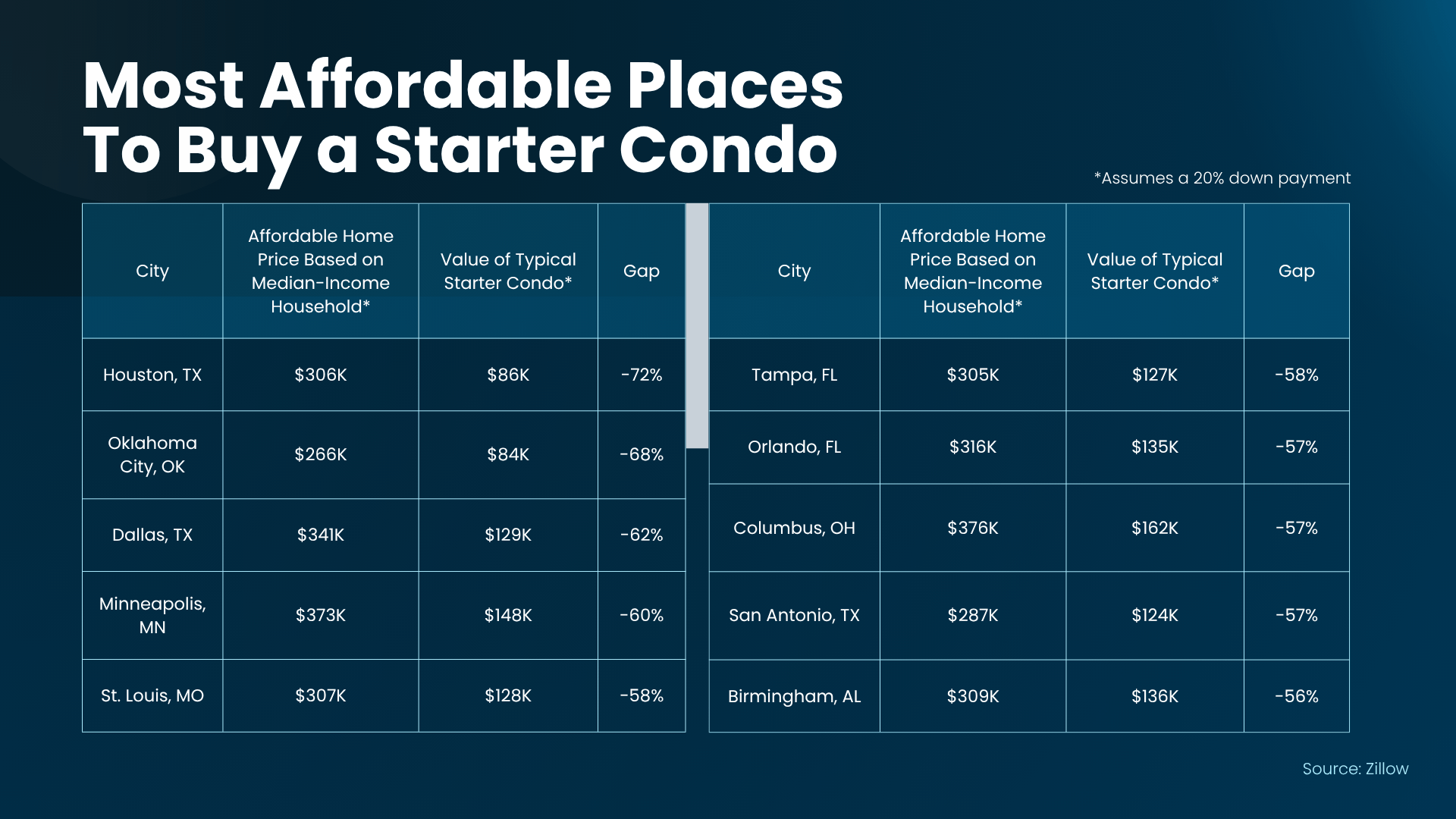
According to research from Zillow, condominiums are among the most commonly affordable housing options in metropolitan areas across the United States. The study reported that starter condos had an average price of $197,468 nationally, approximately 6% below the typical price of a starter home.
That difference may not seem enormous at first, but even a modest reduction in the purchase price can make a difference when you're working with a limited budget. A less expensive property may mean a smaller down payment, a lower mortgage balance, and potentially more manageable monthly payments.
In some cities, the price gap is even more noticeable.
Zillow identified several metropolitan areas where starter condos were priced considerably below the amount a median-income household could typically afford to spend on a home. Houston stood out, with a typical starter condo valued at approximately $85,600, or 72% below the estimated affordable home price for a household earning the area's median income.
These figures show why condos deserve a closer look from buyers who are struggling to find affordable properties.
Of course, housing prices vary by location, and a condo isn't automatically cheaper than every house. Still, the research highlights an important point: looking beyond traditional houses could reveal more affordable ways to become a homeowner.
Why More Buyers Are Choosing Condos for Better Value
Affordability concerns are changing the way people approach homeownership. Instead of insisting on a large detached house, some buyers are becoming more open to attached homes, including condominiums and townhomes.
Ali Wolf, chief economist for New Home Source, has explained that more consumers are showing a willingness to consider smaller floor plans and attached homes as they search for better value.
This shift isn't necessarily about wanting less. It's about making practical choices in a housing market where prices can put pressure on household budgets.
Imagine finding two properties in the same general area. One is a spacious detached house with a large yard, while the other is a smaller condo near shops, public transportation, and other everyday conveniences.
The house may offer more privacy and outdoor space, but the condo could cost less upfront and require less day-to-day maintenance. Depending on your priorities, the condo might provide a better overall fit.
That's why it's important to look beyond appearances when comparing properties.
Consider the total cost of ownership, the location, the available facilities, and the lifestyle each home offers. A property that costs less but requires expensive repairs may not be the best bargain. Likewise, a condo with high monthly association fees may be less affordable than it first appears.
The goal is to find a home that gives you good value without placing unnecessary pressure on your finances.
Condo Living Can Offer Amenities You Might Not Get With a House
Another advantage of condo living is access to shared amenities.
Depending on the development, a condominium community may include a swimming pool, fitness center, landscaped gardens, recreational areas, security services, or shared function rooms.
These facilities can make everyday life more convenient and enjoyable. For example, having a gym in your building could save you the cost of a separate gym membership. A shared swimming pool may give you a place to relax without the expense and maintenance of installing one at home.
However, amenities differ from one development to another. Some condos offer extensive facilities, while others focus on providing basic residential features.
It's also important to remember that these amenities aren't necessarily free. Their upkeep is usually funded through association dues or other charges paid by residents.
Before purchasing a unit, check which facilities are included, whether additional fees apply, and whether the amenities are properly maintained.
Even with these considerations, a well-managed condo community may offer conveniences that would be expensive to create and maintain in a detached house.
What to Consider Before Buying a Condo
Although condos can be an attractive option, they come with trade-offs. Before making a decision, take time to understand what condo ownership involves.
1. Monthly Association Fees
Many condominium communities charge homeowners association or condo association fees to cover shared expenses. Depending on the development, these fees may pay for building maintenance, security, landscaping, elevators, and common facilities.
These costs can add up over time, so don't focus on the mortgage payment alone.
When calculating your budget, include the monthly mortgage, property taxes, insurance, association dues, utilities, and a reasonable allowance for repairs or unexpected expenses. If the building needs major improvements, owners may also face special assessments.
A condo is only affordable if the total monthly cost works for you.
2. Less Privacy and Outdoor Space
Living in a condominium often means sharing walls, hallways, elevators, and common areas with other residents.
You may hear occasional noise from nearby units, and you might have fewer opportunities to enjoy a private garden or outdoor area. Building rules can also affect how you use your property, including restrictions on pets, renovations, and certain activities.
If privacy and outdoor space are essential to you, compare several properties before deciding.
Some condos have balconies, terraces, or nearby parks that can help make up for the lack of a private yard.
3. Shared Maintenance Responsibilities
One benefit of condo living is that the association typically manages certain shared areas and building systems. This can reduce the amount of maintenance you need to handle personally.
However, that doesn't mean you have no maintenance responsibilities.
You may still need to repair appliances, maintain your unit's interior, and pay your share of approved building expenses. The quality of the association's management also matters.
Before buying, review the building's maintenance history, financial condition, rules, and planned repairs. A well-maintained property with a responsible association can make condo ownership easier, while poor management may create unexpected costs.
4. Location and Future Resale Value
Location remains an important factor, regardless of the property type.
A condo close to your workplace, schools, public transportation, shopping centers, and other essential services may offer significant everyday convenience. However, a property's resale value depends on several factors, including local demand, building condition, development quality, and the wider housing market.
Research the neighborhood and compare similar properties before making an offer. Think about how long you plan to live there and whether the property could meet your needs if your circumstances change.
Buying a home is a major financial decision, so it's worth looking beyond the initial price tag.
How to Decide Whether a Condo Fits Your Budget
If you're considering a condo as your first home, start by determining how much you can comfortably afford.
First, calculate your monthly income and regular expenses. Include groceries, transportation, utilities, insurance, debt payments, savings, and other essential costs. Then determine how much you can reasonably allocate to housing without sacrificing your financial stability.
Next, compare condos and single-family homes in the areas where you'd like to live. Look at their purchase prices, estimated mortgage payments, taxes, insurance, association fees, and potential maintenance costs.
Don't forget to account for upfront expenses, such as the down payment, closing costs, moving expenses, and any immediate repairs or improvements.
It's also wise to keep an emergency fund instead of using all your available savings to purchase a property.
If possible, speak with a qualified mortgage professional or financial adviser to understand your financing options. A real estate agent who knows the local market can also help you identify properties that fit your needs and budget.
Most importantly, avoid buying a condo simply because it's cheaper than a house. Make sure you like the property, understand the rules, and feel comfortable with the long-term costs.
The right home should support your life, not make every month a financial struggle.
Don't Let the Search for a Perfect House Delay Your Plans
It's natural to picture your first home as a traditional house with a front yard, a garage, and plenty of room to grow. But your first home doesn't have to match that picture perfectly.
For some buyers, a condominium can provide a practical starting point. It may offer a lower purchase price, convenient amenities, and less responsibility for maintaining outdoor spaces. In the right location, it can also help you enjoy the benefits of homeownership without taking on the cost of a larger property.
You don't have to settle for something that doesn't meet your needs. Instead, consider which features matter most to you right now and which ones you can live without.
Perhaps a private backyard isn't essential. Maybe two bedrooms are enough for the next few years. Or perhaps being close to work and public transportation matters more than having a large living room.
Once you identify your priorities, you'll have a clearer idea of what to look for.
Talk to a real estate agent about including condos in your property search. Explore different neighborhoods, compare prices, and ask questions about association fees, building management, and long-term expenses.
You might discover an option that you hadn't considered before.
Bottom Line
Your first home doesn't have to be a single-family house to be a smart investment in your future.
If high home prices have made buying a property feel out of reach, consider adding condos to your search. A condominium could offer a more affordable entry into homeownership, especially if you're comfortable with a smaller living space and shared facilities.
Just remember to look beyond the purchase price. Compare monthly expenses, association fees, maintenance responsibilities, and the location before making a decision.
The best home isn't necessarily the biggest one. It's the one that fits your lifestyle, supports your goals, and allows you to enjoy homeownership without stretching your budget too thin.
Sometimes, the smartest way to reach your dream isn't to buy more house. It's to find the right home for the life you're building today.
Recent Posts








GET MORE INFORMATION