Credit Score Changes in 2026: 3 Things Every Homebuyer Needs to Know

Buying a home is a major financial decision, and your credit score can play an important role in making that dream a reality. But do you know what credit score you actually need to qualify for a mortgage?
Many people assume they need an exceptionally high score before they can even consider buying a house. Others believe that a few mistakes in their credit history automatically put homeownership out of reach. In reality, the answer is not always that simple.
Mortgage lending is changing, including how lenders evaluate credit scores and determine whether borrowers qualify for home loans. New credit scoring models are creating more opportunities for some consumers, while long-standing misconceptions continue to keep others from exploring their options.
The good news? You may be closer to buying a home than you think.
If homeownership is one of your goals, here are three important things to understand about credit scores and the changing mortgage landscape in 2026.
1. Most Homebuyers Overestimate the Credit Score They Need
Have you ever checked your credit score, decided it was too low, and assumed buying a home was impossible? If so, you are not alone.
Many prospective homebuyers believe mortgage lenders require higher credit scores than they actually do. This misunderstanding can discourage people from exploring their financing options, even when they might qualify for a home loan.
Research from Fannie Mae has consistently shown that consumers tend to overestimate the minimum credit score needed to qualify for a mortgage. In 2023, the average estimated minimum score was 652.
However, 620 has historically been a common benchmark for certain conventional mortgages backed by Fannie Mae and Freddie Mac. Current eligibility requirements can vary depending on the loan program, borrower qualifications, and other factors.
In other words, there is no single credit score that guarantees approval for every mortgage.
Why a Lower Credit Score Does Not Always Mean You Cannot Buy a Home
Your credit score matters, but it is only one part of your financial picture.
Mortgage lenders generally consider several factors when reviewing an application, including your income, existing debts, payment history, available savings, and the amount you want to borrow. The specific requirements depend on the mortgage program and the lender.
For example, someone with a credit score that is lower than expected may still have other financial strengths that support their application. Another person with a higher score might face challenges because of substantial monthly debt or an unstable financial situation.
That is why it is important to look beyond a single number.
You should also remember that different mortgage programs have different qualification standards. Some government-backed loan programs may allow eligible borrowers to qualify with lower credit scores than certain conventional loan programs.
The important thing is to understand which options apply to your circumstances.
Do Not Let Credit Score Myths Stop You From Buying a Home
Assuming you cannot qualify for a mortgage without checking the actual requirements could cost you valuable time.
You might spend several more years renting simply because you believe your credit score is not high enough. Meanwhile, you could be missing an opportunity to understand your options, improve your finances, and prepare for a future home purchase.

2. New Credit Scoring Models Are Changing Mortgage Lending
For many years, the mortgage industry relied heavily on traditional FICO credit scoring models to evaluate borrowers. These models have played a significant role in determining how lenders assess creditworthiness.
However, the industry is evolving.
The Federal Housing Finance Agency (FHFA) has approved newer credit scoring models, including FICO Score 10T and VantageScore 4.0, for use in the mortgage ecosystem under its implementation framework.
The goal is to modernize credit evaluations, encourage competition among scoring providers, and potentially help more creditworthy consumers gain access to homeownership.
So, what does this mean for you?
Why Different Credit Scoring Models Can Produce Different Results
You might check your credit score through a financial app and see one number, only to discover that a lender uses a different score when evaluating your mortgage application.
That does not necessarily mean one of the scores is incorrect.
Different scoring models use different methods to analyze credit information. They may weigh certain aspects of your financial history differently, which can lead to different results for the same person.
For instance, one model may place greater emphasis on particular patterns in your credit history, while another may consider additional information or evaluate existing information differently.
FICO Score 10T, for example, incorporates trended credit data. This can help show how a person's credit behavior changes over time rather than relying only on a snapshot of their current accounts.
VantageScore 4.0 also uses updated scoring methods and can evaluate certain consumers who may have limited traditional credit histories.
According to VantageScore, its model can score approximately 33 million adults who cannot be scored by the Classic FICO model. This could help some consumers become more visible to lenders.
However, being eligible for a credit score does not automatically mean qualifying for a mortgage. Lenders still need to evaluate the applicable lending requirements and the borrower's overall financial situation.
Will the New Credit Models Help You Qualify for a Mortgage?
Potentially, yes.
If a newer scoring model evaluates your credit history differently, the resulting score may be more favorable than the one produced by an older model. For some borrowers, this could improve their chances of meeting a mortgage program's credit requirements.
However, the opposite can also happen. A different model does not guarantee a higher score or better loan terms.
It is also important to understand that the transition to new scoring models involves implementation requirements. Not every lender or mortgage application will necessarily use the same model at the same time.
That means the credit score displayed in your banking app may not match the score used during your mortgage application.
Rather than focusing entirely on one number, ask your mortgage professional which scoring model and lending requirements apply to your situation.
Understanding this difference can help you make better financial decisions and avoid unnecessary confusion.
3. Build Strong Credit Habits and Work With a Mortgage Professional
Credit scoring systems may change, but the basic habits that support a healthy credit profile remain important.
Whether you are planning to purchase a home next year or simply exploring your options, taking care of your credit today can put you in a stronger position later.
Think of your credit history as the foundation of a house. You cannot always control every change in the lending industry, but you can take steps to make your financial foundation stronger.
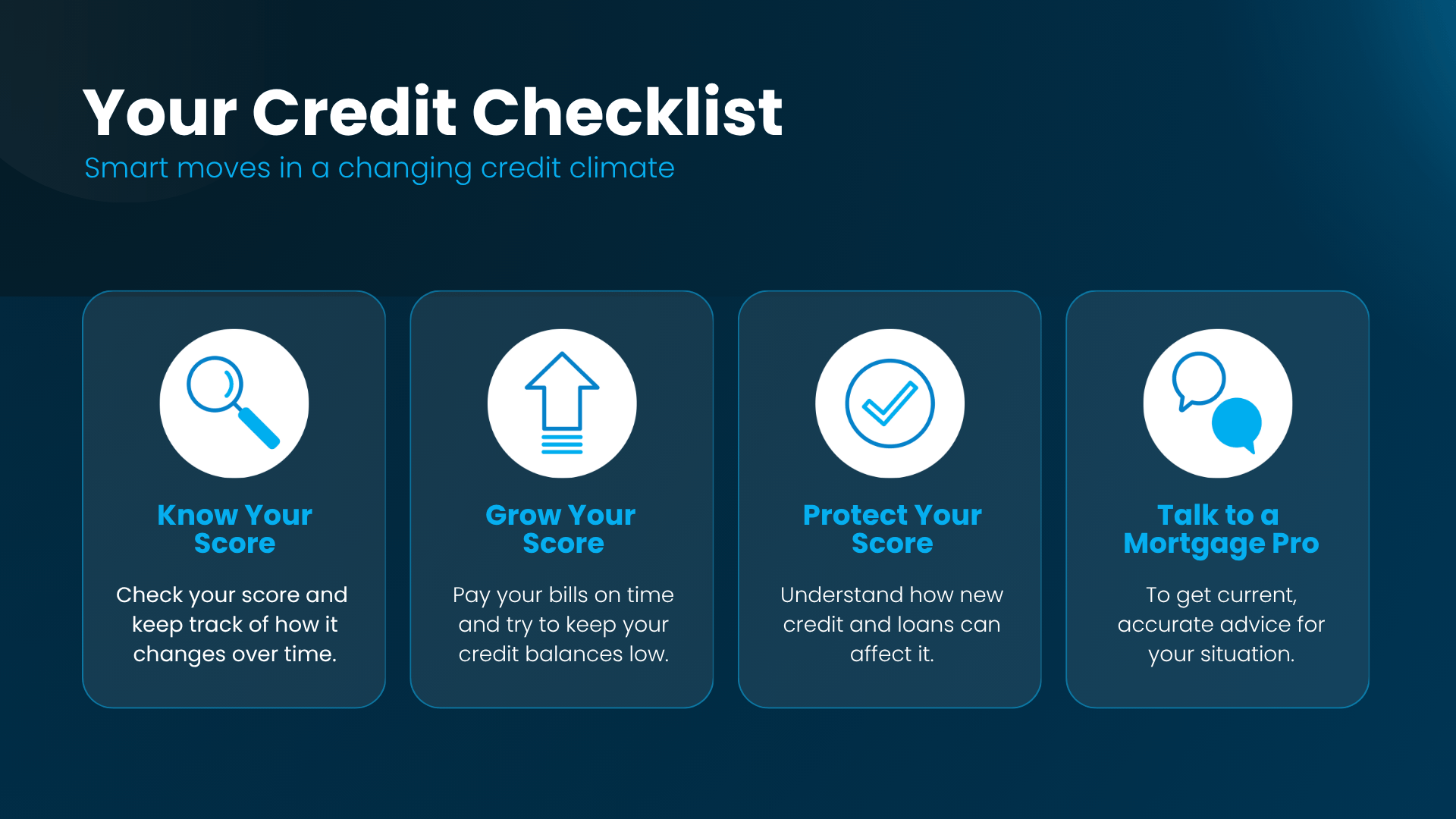
Pay Your Bills on Time
Payment history is an important factor in many credit scoring models.
Late payments can negatively affect your credit profile, so make a habit of paying your bills by their due dates. Consider setting up payment reminders or automatic payments when appropriate and affordable.
If you have missed payments in the past, do not assume your financial future is ruined. Focus on making consistent payments moving forward and managing your accounts responsibly.
Building a positive payment history takes time, but steady progress matters.
Keep Your Credit Card Balances Under Control
Using credit cards responsibly can help you manage your finances and build a stronger credit profile.
However, carrying high balances compared with your available credit can hurt your credit score under many scoring models.
For example, if your credit card has a limit of $5,000 and your balance is $4,500, you are using 90% of your available credit. That is a high utilization rate.
Reducing your balance can lower your credit utilization and may help improve your score, although the impact depends on your overall credit profile and the scoring model used.
You do not necessarily need to stop using credit cards altogether. The key is to avoid taking on more debt than you can comfortably repay.
Avoid Opening Too Many New Credit Accounts at Once
Applying for several credit cards or loans within a short period can affect your credit profile.
Depending on the type of application and scoring model, multiple hard inquiries may lower your score temporarily. Opening new accounts can also increase your financial obligations and make it harder to manage your monthly payments.
If you plan to apply for a mortgage soon, be especially careful about taking on unnecessary debt.
Before financing a new vehicle, purchasing expensive items on credit, or opening another credit card, consider how the decision could affect your homebuying plans.
When you are preparing for a mortgage, consistency and careful financial management can make a difference.
Review Your Credit Reports for Errors
Your credit score is based on information in your credit history, so it is important to make sure that information is accurate.
Review your credit reports for unfamiliar accounts, incorrect balances, outdated information, or payments that may have been reported incorrectly.
If you find an error, follow the appropriate process to dispute it with the relevant credit reporting agency or creditor.
Correcting inaccurate information will not automatically increase your score, but it can help ensure that lenders evaluate your credit history using accurate data.
Talk to a Mortgage Professional Before Making Major Decisions
You do not have to figure out every mortgage requirement on your own.
A qualified loan officer or mortgage professional can help you understand the credit standards that apply to different loan programs, review your financial readiness, and identify areas that may need improvement.
They can also help you understand how your income, debts, savings, and credit history work together when lenders evaluate your application.
If you are not ready to buy yet, that conversation can still be useful. You may discover that you need to reduce existing debt, save for upfront costs, or allow more time to strengthen your credit profile.
Having a plan is much better than guessing.
Bottom Line: Your Credit Score May Not Be the Barrier You Think It Is
The mortgage industry is changing, and credit scoring is becoming part of that evolution. New scoring models may help some consumers receive a more complete evaluation of their creditworthiness, while updated lending practices could create additional opportunities for eligible homebuyers.
Still, one important lesson remains: Do not let credit score assumptions make your homebuying decisions for you.
A score you see in an app does not always tell the whole story. Mortgage eligibility depends on the specific loan program, the scoring model used, and your broader financial circumstances.
Instead of waiting until your credit score reaches an arbitrary target, take the time to understand where you stand today.
Pay your bills on time, manage your debt carefully, check your credit reports, and seek professional guidance when you need it. These steps can help you prepare for homeownership, even if you are not ready to apply for a mortgage just yet.
Remember, buying a home is not just about reaching a particular credit score. It is about building a financial position that allows you to take on a mortgage responsibly and comfortably.
You might be closer to owning a home than you think. The first step is finding out what is actually possible.
Recent Posts









GET MORE INFORMATION