A Fixer-Upper Could Be Your Ticket to Affordable Homeownership

If the homes you love keep landing outside your budget, it might be time to look at properties other buyers tend to overlook. While move-in-ready homes are appealing, a fixer-upper could offer a more affordable path to homeownership without giving up the neighborhood or lifestyle you want.
Buying a home is already a major financial commitment. Add rising prices, mortgage rates, and competition, and finding something that fits your budget can feel like searching for a needle in a haystack. But what if the home you've been looking for isn't perfect yet?
A fixer-upper might be worth a second look.
Of course, a home that needs work isn't the right choice for everyone. Some buyers prefer the convenience of moving into a property that requires little to no maintenance. Others are willing to roll up their sleeves, make improvements over time, and turn an overlooked property into something special.
And more buyers are beginning to recognize that opportunity. Danielle Hale, Chief Economist at Realtor.com, explains:
"Fixer-uppers give buyers a way to break into the housing market at a time when affordability is still stretched thin. For those with the vision. . . fixer-uppers provide both a starting point in the market and the chance to create a home that's truly their own."
If you're willing to look beyond outdated kitchens, worn flooring, or walls that could use a fresh coat of paint, here's why a fixer-upper could be a smart option for your homebuying journey.
1. Fixer-Upper Homes Can Offer a Lower Purchase Price
One of the biggest advantages of buying a fixer-upper is the opportunity to purchase a home at a lower upfront price.
Because these properties often need repairs, updates, or cosmetic improvements, sellers may price them below comparable homes that are already renovated. According to AmeriSave, fixer-uppers typically sell for 20% to 30% less than their market value.
That difference can be significant.
To illustrate the potential savings, KCM applied a 25% discount, which falls in the middle of that range, to the median home price reported by the National Association of Realtors (NAR). This is an example rather than the average price of a fixer-upper, but it demonstrates how the savings could exceed $100,000.
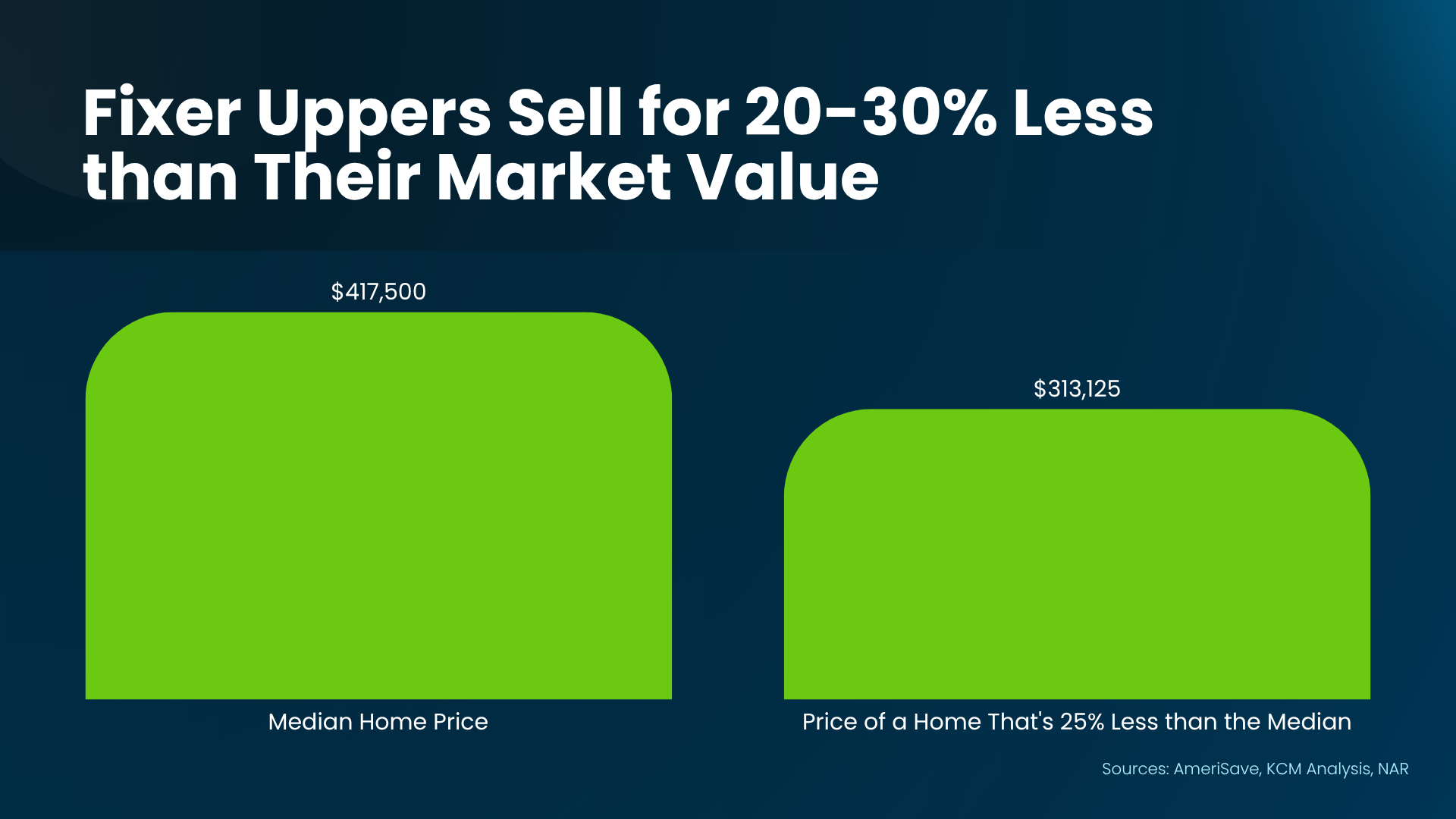
For buyers struggling to find a home within their budget, that price difference could make homeownership feel much more achievable.
Think about it this way: Would you rather pay a premium for someone else's renovations or purchase a home with potential and make improvements that reflect your own preferences?
The answer depends on your priorities, finances, and willingness to take on a project.
Build Your Home Improvement Budget Before Buying
A lower purchase price doesn't automatically mean a cheaper home overall.
Repairs can add up quickly, especially when you're dealing with major systems such as roofing, plumbing, electrical wiring, or heating and cooling. What initially looks like a bargain could become expensive if you underestimate the work involved.
Before making an offer, consider these steps:
-
Get professional inspections. Understand the property's condition before committing to the purchase.
-
Request contractor estimates. Know what repairs and renovations are likely to cost.
-
Set a realistic renovation budget. Include a contingency fund for unexpected expenses.
-
Prioritize essential repairs. Address safety, structural concerns, and major systems before cosmetic improvements.
-
Plan renovations in stages. If the home is safe and functional, some updates may be completed later as your budget allows.
The goal is to make sure the savings at purchase remain meaningful after the renovation costs.
2. Renovation Loans Can Help Finance Your Home and Repairs
What if you don't have enough cash to purchase a property and immediately pay for all its renovations?
You may not need to finance everything separately.
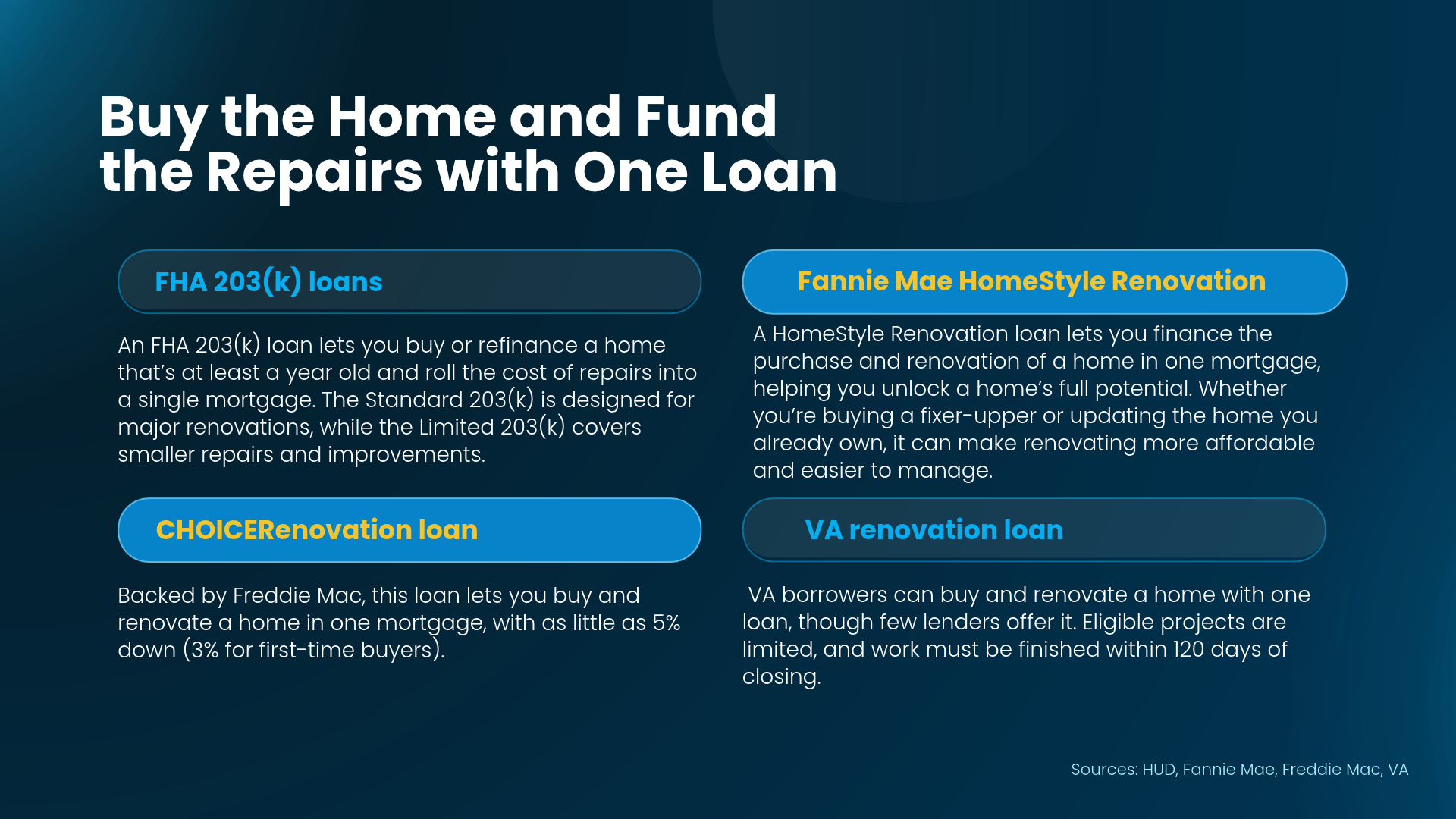
Some mortgage programs allow eligible buyers to combine the purchase price of a home and the cost of approved renovations into a single loan. This can help reduce the need to pay for every improvement out of pocket immediately after closing.
Depending on your eligibility, property, and lender, you may want to explore these renovation mortgage options:
FHA 203(k) Renovation Loan
The Federal Housing Administration's FHA 203(k) program allows eligible borrowers to finance a home purchase or refinance along with qualifying renovation costs.
It can be particularly useful for buyers interested in improving an older property that needs more than basic cosmetic updates.
Learn more through the HUD FHA 203(k) program.
Fannie Mae HomeStyle Renovation Loan
The HomeStyle Renovation mortgage from Fannie Mae allows borrowers to finance eligible renovation expenses as part of their mortgage.
Depending on program requirements, improvements can include a range of upgrades, repairs, and renovations.
Explore the Fannie Mae HomeStyle Renovation program.
Freddie Mac CHOICERenovation
Freddie Mac's CHOICERenovation mortgage is another option that can combine home financing with renovation expenses.
It may be worth discussing with a lender if you're considering a property that needs improvements.
Visit the Freddie Mac CHOICERenovation program.
VA Renovation Financing
Eligible veterans, service members, and other qualifying borrowers may also have renovation financing options through VA-backed home loans.
The available programs and requirements depend on the lender and the type of improvements being completed.
Check the VA home loan programs for additional information.
Keep in mind that each renovation loan has its own eligibility requirements, lender guidelines, renovation limits, and approval process. Not every lender offers every program.
Before choosing a property, talk with a trusted mortgage professional about financing options and how they fit your renovation plans.
3. Local Home Renovation Incentives Could Add More Savings
Here's another opportunity buyers sometimes overlook: local renovation incentives.
Depending on where you're buying, your city or county may offer programs that encourage homeowners to rehabilitate older properties, improve housing conditions, or invest in designated neighborhoods.
Some programs provide property tax incentives, rehabilitation assistance, or other benefits to eligible homeowners.
These incentives aren't available everywhere, and the requirements can vary considerably. However, researching local programs before purchasing a fixer-upper could help you identify additional financial opportunities.
How to Find Home Rehabilitation and Property Tax Incentives
Start with your local government's official website.
Look for sections related to housing, community development, property taxes, or neighborhood revitalization. You can also use the website's search bar with terms such as:
-
"[City or County Name] home rehabilitation program"
-
"[City or County Name] property tax incentive"
-
"[City or County Name] housing repair assistance"
-
"[City or County Name] residential renovation incentives"
You can also contact your local housing department or consult a tax professional to determine whether you qualify for any available programs.
A little research could reveal opportunities you wouldn't have found otherwise.
4. A Fixer-Upper Gives You More Freedom to Personalize Your Home
There's something exciting about transforming a house into a home that reflects your personality.
With a fixer-upper, you may have more freedom to decide what gets updated, which materials are used, and how different spaces come together.
Instead of paying for a renovation style chosen by someone else, you can make decisions based on your own preferences and priorities.
Want a brighter kitchen? Prefer open shelving? Dreaming of a home office or a more functional living room?
A fixer-upper gives you the opportunity to work toward those goals.
You don't necessarily need to complete everything immediately, either. Depending on the property's condition and your finances, you may be able to spread certain improvements over time.
That said, personalization should come after essential repairs. A beautiful kitchen won't mean much if the roof is leaking or the electrical system needs attention.
5. Work With a Real Estate Agent Who Understands Fixer-Uppers
Finding the right fixer-upper requires more than spotting a low asking price.
You need to understand the property's condition, potential renovation expenses, neighborhood value, and whether the purchase makes financial sense.
A knowledgeable real estate agent can help you identify homes with potential, compare prices with similar properties, and understand local market conditions.
They can also help you evaluate whether a home is worth pursuing or whether the repair costs might outweigh the potential benefits.
The right guidance can make a major difference, especially if you're buying your first home or navigating renovation financing for the first time.
Is a Fixer-Upper the Right Home for You?
A fixer-upper isn't simply a cheaper house. It's a home that requires a different approach to buying, budgeting, and planning.
For some buyers, the extra work is worth the opportunity to enter the housing market at a more manageable price. For others, the uncertainty and renovation responsibilities may outweigh the potential savings.
Before making a decision, ask yourself:
-
Can I comfortably afford the purchase price and estimated repairs?
-
Do I have enough savings for unexpected expenses?
-
Is the property structurally sound?
-
Can I realistically manage the renovation timeline?
-
Will the completed home meet my needs?
-
Does the total investment make sense compared with other homes in the area?
If the answers align with your financial goals, a fixer-upper could be worth exploring.
The Bottom Line: Your Dream Home Doesn't Have to Be Move-In Ready
If move-in-ready homes keep stretching your budget, don't overlook properties that need a little TLC.
A fixer-upper could offer a more affordable starting point, the opportunity to personalize your space, and a chance to build toward the home you've always wanted.
The key is planning ahead. Understand the property's condition, estimate renovation costs, explore financing options, and work with professionals who can help you make informed decisions.
You don't have to create your dream home overnight. Sometimes, the best homes are the ones you build your vision around, one improvement at a time.
Ready to explore fixer-upper homes in the neighborhoods you love?
Let's connect and find properties with potential that fit your budget, goals, and vision for homeownership. Your next home might be waiting behind a fresh coat of paint.
Recent Posts





GET MORE INFORMATION