Your Home May Be Worth More Than You Think: How Home Equity Can Shape Your Next Move

When was the last time you found out what your home is actually worth?
Not a number from an online home value calculator. Not what your neighbor’s house sold for. And not an estimate you received years ago.
We mean the current market value of your specific home.
For many homeowners, it has been years since they had a professional opinion on their property’s value. And if you have been thinking about moving but higher home prices and mortgage rates have made you hesitate, there is one number you may want to revisit first: your home equity.
You might be sitting on more purchasing power than you realize.
Your Home Value May Have Changed Significantly
The housing market looks very different today than it did several years ago. Home prices have increased substantially in many areas, giving long-term homeowners an opportunity to build significant equity.
Equity is essentially the portion of your home that you own outright. It can grow in two major ways: your property may appreciate in value, and your mortgage balance may decrease as you make payments.
Think of it like filling a bucket one drop at a time. Every mortgage payment can add to what you own, while rising home values can make the bucket grow even faster.
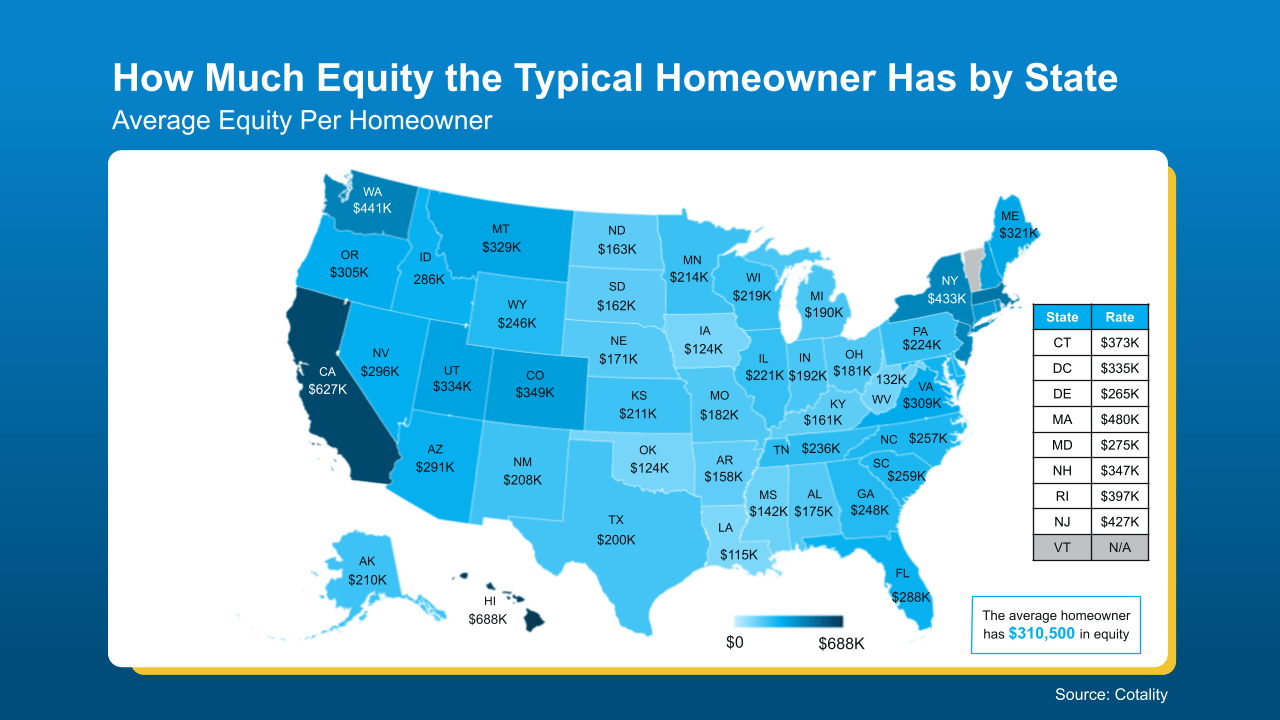
According to Cotality, the typical U.S. homeowner with a mortgage has accumulated approximately $310,500 in home equity.
That is a substantial amount of wealth tied to an asset many homeowners use every day.
Of course, your situation may be very different from the national average. Home values, mortgage balances, and appreciation vary from one market to another.
That is why the more important question is not, “What is the average homeowner’s equity?”
It is:
How much equity have you built in your home?
Why Your Home Equity Matters More Than You Think
It is easy to look at today's housing market and focus on the obstacles.
Maybe mortgage rates are higher than the rate you currently have. Maybe homes in your area cost considerably more than they did when you bought yours. Perhaps the thought of giving up an ultra-low mortgage rate makes moving seem almost impossible.
Those concerns are completely understandable.
But there is another side of the equation that homeowners sometimes overlook.
You are not starting from zero.
If you have owned your home for several years, you may have accumulated a significant amount of equity. That equity can change the financial picture when you sell and purchase another property.
Instead of simply comparing your current mortgage payment with the potential payment on a new home, you need to consider the full picture—including what you could potentially bring from the sale of your existing property.
That could make your next move more achievable than it first appears.
Your Home Equity Could Help Fund Your Next Move
Maybe your current house has started to feel a little too small.
Perhaps your family has grown, you want a home office, or you simply need a different layout. On the other hand, maybe the opposite is true. The kids have moved out, the extra bedrooms rarely get used, and you are ready for something smaller and easier to maintain.
Whatever the reason, your accumulated equity could help bridge the gap between where you live today and where you want to live next.
Yes, your next home may cost more than the one you purchased years ago.
But if your current home has also increased substantially in value, the difference may not be as overwhelming as it looks on paper.
Here are a few ways your equity could potentially work in your favor.
1. Put More Money Down on Your Next Home
One of the most straightforward ways to use proceeds from your current home is toward the down payment on your next property.
A larger down payment means borrowing less money. And when mortgage rates are higher than they were several years ago, reducing the amount you need to finance can have a meaningful effect on your monthly payment.
For example, imagine two buyers purchasing the same home. One needs to finance nearly the entire purchase price. The other brings a substantial amount of equity from a previous home.
The purchase price is identical.
The financing situation is not.
Your equity could give you more flexibility when structuring the next purchase.
2. Potentially Purchase Your Next Home With Cash
This may sound surprising, but some homeowners have accumulated enough equity to purchase another property without taking out a mortgage.
According to the National Association of Realtors, 26% of repeat buyers paid cash for their homes in July.
That does not mean every homeowner can—or should—buy their next home with cash. There are plenty of financial considerations to weigh before making that decision.
But it illustrates an important point: homeowners who have built substantial equity may have more options than they realize.
Equity can provide leverage, flexibility, and purchasing power.
3. Stay Put and Improve the Home You Already Own
Moving is not the only way to take advantage of your home’s value.
What if you love your neighborhood, your commute, your community, and your location—but your house no longer works for your lifestyle?
Maybe the kitchen feels cramped. Perhaps you need another bedroom, a home office, or a more functional outdoor space.
In that case, renovating could be worth considering.
Depending on your financial circumstances and available equity, you may be able to use some of your home’s accumulated value to fund improvements.
Sometimes the best next move is not moving at all.
It is making the home you already own work better for you.
Don't Let Mortgage Rates Tell the Whole Story
Mortgage rates matter. There is no getting around that.
If you currently have a mortgage rate significantly below today's rates, replacing it with a new loan can feel like giving up a valuable financial advantage.
But focusing exclusively on the interest rate can leave out another major part of the equation: your equity.
Imagine looking at your home through a window that only shows one side of the street. You might see the traffic and think, “This is a terrible time to drive.”
But what about the open road on the other side?
Your mortgage rate is one part of the decision. Your home's current value, outstanding mortgage balance, potential sale proceeds, next-home price, down payment, and monthly budget all matter too.
The right question is not necessarily, “Are mortgage rates low enough for me to move?”
It may be:
“Given my equity and financial situation, what opportunities do I have right now?”
That is a much more useful question.
Find Out What Your Home Is Worth Today
Here is where many homeowners get stuck.
They know prices have changed. They may even have a rough idea of what similar houses are selling for. But they do not know what their own property could realistically sell for in today's market.
That uncertainty can make a major financial decision feel like guesswork.
An online valuation tool can give you a starting point, but your home's actual market value depends on details an automated estimate may not fully understand.
Condition matters.
Location matters.
Recent comparable sales matter.
Updates and renovations matter.
Market conditions matter.
Even seemingly small features can influence how buyers perceive a property.
That is why a professional home equity assessment can be so valuable.
Instead of relying on a generic estimate, you can get a more personalized look at your property's potential market value, your estimated equity, and what those numbers could mean for your options.
Your Equity Could Change the Conversation
Maybe you have been telling yourself that moving is too expensive.
Maybe you have assumed that your current mortgage rate makes selling unrealistic.
Or perhaps you simply have not considered moving because you have no idea how much equity you have built.
But what if the number is higher than you expect?
That one piece of information could change the conversation.
You might discover that you have enough equity to make a larger down payment. You might find that downsizing is more financially comfortable than you thought. You could even realize that renovating your current home makes more sense than selling.
The goal is not to convince yourself that you should move.
The goal is to understand what you can do.
The Bottom Line
Your home is more than the place where you live. For many homeowners, it is also one of their largest financial assets.
If it has been years since you had your property professionally valued, now may be a good time to take another look.
A personalized Home Equity Assessment can help you understand what your home could potentially sell for, how much equity you may have accumulated, and what that equity could mean for your next decision.
You do not have to commit to selling.
You do not have to buy another house.
You do not even have to move.
First, get the number.
Because once you know what your home is really worth, you can stop guessing about your options—and start making decisions based on what is actually possible.
Recent Posts










GET MORE INFORMATION