Thinking About Using Your 401(k) for a Home Down Payment? Explore These Options First

For many Americans, buying a home can feel like a race against rising prices, mortgage costs, and the challenge of saving enough cash for a down payment. So, when you look at your 401(k) balance and see a substantial amount sitting there, it’s understandable to wonder: Could that money help me buy a home sooner?
It’s a tempting question.
If you’ve spent years contributing to your retirement account, your 401(k) may represent one of the largest pools of money you have. When your dream home is within reach but your down payment savings aren’t quite there, using some of those retirement funds can seem like a shortcut.
But is it really a shortcut—or could it create a financial detour later?
Before you move money out of your retirement account, it’s important to understand what you could gain, what you could potentially lose, and what other home-buying options may be available. Your 401(k) can be a valuable financial resource, but it was primarily designed to support your future retirement—not necessarily your next home purchase.
Why Using Your 401(k) for a Down Payment Can Be Tempting
There’s a simple reason the idea of tapping into a 401(k) sounds appealing: the money is already yours.
Unlike a separate savings account that may take years to build, your retirement account could already contain tens or even hundreds of thousands of dollars. Data from Empower shows that median 401(k) balances among people in their 40s through 60s can reach six figures.

That can make a retirement account look like a financial safety net with a door you can simply open.
Imagine you’ve found a house you love. You have steady income, your credit is in decent shape, and the monthly mortgage payment looks manageable. The one obstacle? You’re short on the down payment.
Your 401(k) balance might suddenly look like the missing puzzle piece.
Depending on your employer's retirement plan and your circumstances, you may have access to a 401(k) loan or, in some situations, a withdrawal. However, these two approaches work differently, and neither should be treated as free money.
A financial decision that solves today's down-payment problem could potentially create tomorrow's retirement problem.
401(k) Loan vs. 401(k) Withdrawal: They Aren’t the Same
One of the most important things to understand is that borrowing from a 401(k) and withdrawing money from it are not identical strategies.
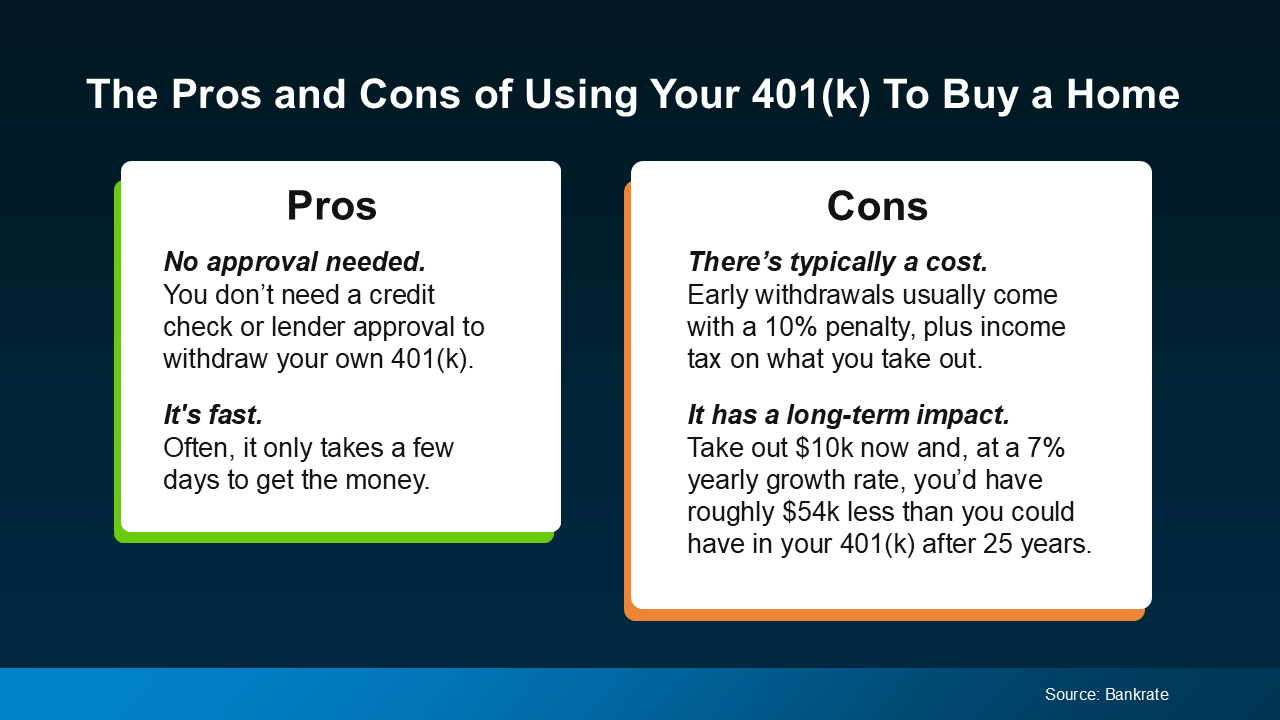
With a 401(k) loan, you generally borrow money from your retirement account and repay it according to the plan's rules. You may pay interest on the loan, but the interest generally goes back into your account.
That can sound attractive.
However, there are risks. Your employer's plan determines whether loans are available and what terms apply. If you leave your job, for example, the outstanding loan could become an immediate financial concern depending on the plan and applicable rules. Failure to handle the loan properly can also result in tax consequences.
A withdrawal is different. Instead of borrowing the money, you're taking retirement funds out of the account. Depending on your age, circumstances, and the type of withdrawal, taxes and potentially an early-withdrawal penalty may apply.
That's why the phrase “I'll just take some money from my 401(k)” can be much more complicated than it sounds.
Before touching your retirement funds, make sure you understand exactly which option you're considering and how it could affect your taxes, retirement savings, and overall financial picture.
The Hidden Cost: Lost Investment Growth
Here's the part that's easy to overlook.
When you remove money from a retirement account, you're not just removing today's dollars. You're potentially removing years of future investment growth.
Think of retirement savings like a snowball rolling downhill. Over time, contributions and investment returns can build on one another. Taking money out early can make that snowball smaller—and it may take a long time to rebuild.
For example, suppose you take $30,000 from retirement savings today. The immediate benefit is obvious: you've got $30,000 that can potentially help with your home purchase.
But what could that money have become over the next 20 or 30 years if it had remained invested?
The answer depends on investment performance, fees, taxes, contributions, and many other factors. That's why a financial professional can be particularly valuable here. They can help you compare the immediate benefit of owning a home with the potential long-term opportunity cost of reducing your retirement investments.
The question isn't simply, “Can I afford to take the money out?”
It's also, “What could this money have done for me if I left it alone?”
A Smaller Down Payment May Be Another Path
If your biggest obstacle is saving enough for a down payment, don't automatically assume that you need to raid your retirement account.
Depending on your circumstances, there may be mortgage programs that require significantly less money upfront.
For example, qualified buyers may be able to use an FHA loan with a down payment as low as 3.5%, depending on factors such as credit qualifications and the specific loan situation.
There are also conventional mortgage options that may allow eligible buyers to put down a relatively small percentage.
Of course, putting less money down can have trade-offs. A smaller down payment can mean a larger loan balance, potentially higher monthly payments, and mortgage insurance depending on the loan program and your circumstances.
Still, it's worth comparing these costs against the potential consequences of taking money from your retirement account.
Sometimes the best solution isn't finding more money. It's finding a financing strategy that works with the money you already have.
Don't Forget About Down Payment Assistance Programs
Another option many prospective homeowners overlook is down payment assistance.
Depending on where you live and whether you meet the eligibility requirements, programs may be available to help qualified buyers with some of their down payment or closing costs.
These programs can vary significantly. Some are offered by state or local governments, while others may come through housing agencies or other organizations. Eligibility can depend on income, location, property type, first-time-buyer status, and other factors.
That means it's worth doing your homework before assuming your 401(k) is your only source of funds.
A mortgage professional or housing counselor may be able to help you identify programs you could potentially qualify for.
Why leave a potential resource unexplored?
Your Down Payment Isn't the Only Home-Buying Expense
There's another reason to be cautious about putting every available dollar into your down payment.
Buying a house costs more than the down payment.
You may also need to budget for closing costs, inspections, appraisal expenses, moving costs, prepaid taxes and insurance, repairs, and other upfront expenses.
And then there's the unexpected stuff.
A house has a funny way of producing expenses at exactly the moment your bank account wants a break.
The water heater might fail. The air conditioner could need service. A roof repair could suddenly become urgent. Even a perfectly maintained home comes with ongoing maintenance and ownership costs.
That's why draining your savings—or your retirement account—to make the down payment isn't necessarily the strongest financial move.
A healthy home-buying plan should consider not only how you get the keys, but also how comfortably you can afford to keep them.
Look at the Entire Financial Picture
Before deciding how much to put down, take a step back.
Look at your income, existing debt, emergency savings, retirement contributions, credit profile, monthly expenses, and expected housing costs.
Then ask yourself a few straightforward questions:
- Will I still have an emergency fund after closing?
- Can I comfortably afford the monthly mortgage payment?
- What happens if my income temporarily decreases?
- Am I on track with my retirement savings?
- How much would taking money from my 401(k) reduce my future retirement balance?
- Are there lower-cost down-payment alternatives available to me?
- What taxes, penalties, fees, or repayment requirements could apply?
These questions may not be as exciting as touring your dream kitchen, but they're the questions that can protect your financial future.
Don't Let a Home Purchase Become a Retirement Setback
Owning a home is an important financial goal, but it shouldn't automatically come at the expense of another major goal: being financially secure in retirement.
Think of your finances as a house itself. Every part has a purpose. Your emergency savings provide stability. Your retirement investments support your future. Your home can provide shelter, equity, and potentially long-term value.
You don't want to strengthen one wall by accidentally weakening another.
That doesn't mean using a 401(k) for a home purchase is always the wrong decision. Every buyer's situation is different, and there may be circumstances in which a 401(k) loan or other retirement-account strategy makes sense.
The key is to understand the trade-offs before making the move.
Talk to the Right Professionals Before You Decide
Buying a home often involves several professionals, and each can help you answer a different piece of the puzzle.
A financial advisor can help you evaluate the impact on your retirement strategy and broader finances.
A mortgage professional can explain available loan programs, down-payment requirements, interest rates, and estimated monthly payments.
A tax professional can help you understand potential tax consequences associated with withdrawing or borrowing retirement funds.
You don't necessarily need one person to answer every question. In fact, getting multiple perspectives can give you a much clearer picture before you commit to a major financial decision.
The Bottom Line
Using your 401(k) to help buy a home may sound like an easy way to overcome a down-payment hurdle, but it's a decision that deserves careful consideration.
Your retirement savings aren't simply another checking account. Taking money out can involve taxes, penalties, repayment requirements, and—perhaps most importantly—the loss of potential investment growth over time.
Before reaching into your retirement account, explore alternatives such as low-down-payment mortgage programs and down payment assistance. Look at the complete cost of buying a home, including closing expenses, monthly payments, maintenance, and emergency savings.
Most importantly, don't make the decision based solely on how much money you can access today.
A home is a long-term investment. Your retirement is, too.
The smartest move is to build a plan that gives you a path toward homeownership without unnecessarily sacrificing your financial future. Talk with qualified financial and mortgage professionals, compare your options, and make sure the numbers work not just for closing day—but for the years that come after you get the keys.
Recent Posts









GET MORE INFORMATION