Data Centers Are Moving Closer to Homes: What It Could Mean for Homeowners and Buyers
When you think about the things that matter most when buying or selling a home, a data center probably isn't at the top of the list.
You’re more likely to think about the quality of nearby schools, commute times, neighborhood safety, property taxes, or how close you’ll be to family and everyday conveniences. But what happens when a massive building packed with computer servers becomes part of the neighborhood?
That question is becoming increasingly relevant.
Data centers are expanding into more communities across the United States, driven by the growing demand for cloud computing, artificial intelligence, streaming, online services, and digital infrastructure. As these facilities become more common, homeowners and prospective buyers are naturally asking what their presence could mean for local real estate, utility costs, infrastructure, and quality of life.
Is living near a data center automatically bad for property values? Not necessarily.
In fact, the reality is considerably more complicated. Like any major development, data centers can create opportunities while also bringing challenges. Understanding both sides can help you make a more informed decision before buying or selling a home.
Data Centers Are Expanding Into More Communities
Data centers aren't exactly new. What has changed is how quickly they are appearing in different parts of the country.
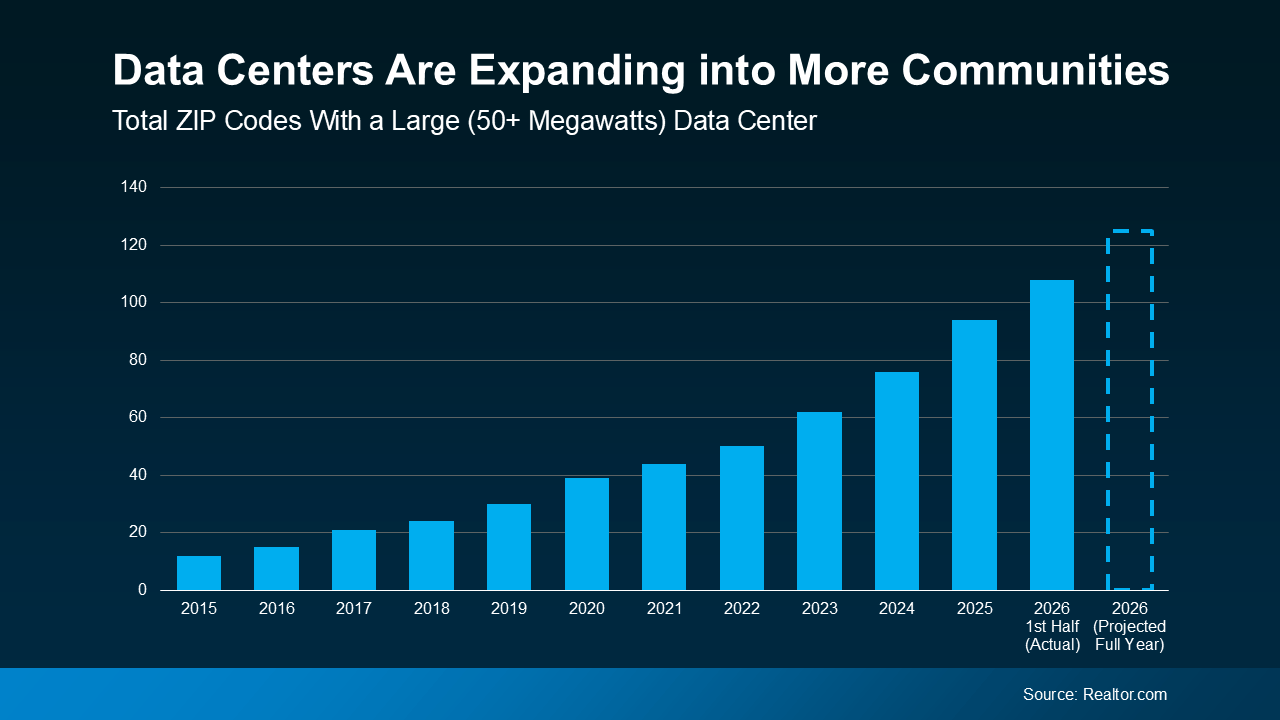
According to Realtor.com, only around a dozen ZIP codes had a large data center in 2015. By the first half of 2026, that number had increased to more than 100, with additional growth expected before the end of the year.
That's a significant expansion in just over a decade.
Much of this growth is happening in states including Texas, Virginia, Georgia, Pennsylvania, Ohio, Utah, Illinois, Arizona, Indiana, and Nevada. As technology companies and other businesses require more computing capacity, communities with available land, electricity, fiber infrastructure, and other necessary resources can become attractive locations for new facilities.
And that creates a new consideration for real estate.
A buyer searching for a home today may discover that a data center is already operating nearby. Another buyer may learn that one has been proposed for the area. For existing homeowners, a large facility could suddenly become part of the neighborhood's future development plans.
So naturally, the question becomes: What does a nearby data center mean for home values?
Can a Nearby Data Center Affect Home Values?
This is probably the biggest question for homeowners.
If you're considering purchasing a property, you may wonder whether a data center could eventually make the home harder to sell. If you're already a homeowner, you may be concerned that a new facility could reduce your property's value.
The good news is that current evidence doesn't suggest that data centers automatically cause home values to rise or fall.
Researchers have compared ZIP codes containing large data centers with similar communities without them. According to reporting from HousingWire, home values in these data-center ZIP codes generally followed the performance of comparable communities, without statistically meaningful gains or losses. Listing prices also showed a modest initial increase around some facility openings.
That's an important distinction.
Simply having a data center somewhere in your ZIP code doesn't appear to be a reliable predictor of whether your home will become more or less valuable.
Think of it like adding a new business to a growing neighborhood. The business itself doesn't determine the value of every house. What matters is how it fits into the surrounding area, how close individual properties are, what infrastructure is added, and how residents experience the development.
The same principle applies to data centers.
A home directly adjacent to a large facility may have a very different experience from a home several miles away. Location, visibility, traffic, noise, zoning, future construction, and the character of the surrounding neighborhood can all influence buyer perceptions.
So rather than asking, "Will a data center hurt property values?", a better question is:
"What specific impact could this particular facility have on this particular neighborhood?"
The Potential Benefits of Living Near a Data Center
Large-scale development can have significant effects on a community. While data centers aren't traditional neighborhood amenities, their arrival can sometimes contribute to broader economic growth.
Economic Growth and Local Development
A new data center can become part of a larger development trend.
Large technology facilities require land, construction services, utilities, transportation infrastructure, and ongoing maintenance. That activity can generate economic benefits for the surrounding community.
In some cases, increased property tax revenue can also give local governments additional resources to invest in public services and infrastructure.
Of course, the actual benefit depends on local tax arrangements and how that revenue is used. But for communities experiencing economic expansion, a data center can be one component of a much larger growth story.
Infrastructure Improvements
Data centers require substantial infrastructure to operate.
That can include electricity transmission, substations, fiber-optic networks, roads, and other supporting systems. As a result, communities hosting these facilities may see infrastructure improvements that can also benefit other residents and businesses.
For homeowners, better connectivity and improved roads can be meaningful advantages.
After all, infrastructure isn't particularly exciting until you don't have enough of it.
Jobs and Business Activity
Data centers also create economic activity during both construction and operation.
Construction projects can bring temporary employment, while ongoing facilities may require technicians, engineers, security personnel, maintenance workers, and other professionals.
Those jobs can contribute to local spending and potentially increase demand for nearby housing and services.
That doesn't mean every data center will transform its surrounding community into a booming economic hub. But it can become one piece of the local economy.
The Potential Downsides Homeowners Should Consider
The benefits aren't the whole story.
A data center is a major industrial-scale facility, and homeowners should understand what that can mean before purchasing property nearby.
Large Buildings Can Change the Landscape
Data centers aren't exactly subtle.
They can occupy large parcels of land and may be accompanied by substations, transmission infrastructure, security systems, roads, and other supporting facilities.
For some homeowners, that may not matter. For others, the change in scenery could affect how attractive the neighborhood feels.
If you're considering a home near a proposed facility, don't just look at the property itself. Look beyond the backyard.
What will the area potentially look like five or ten years from now?
Noise May Be a Consideration
Noise is another issue worth investigating.
Cooling systems, generators, construction activity, delivery vehicles, and other equipment can create sound. How noticeable that noise is will depend heavily on the facility's design, distance from homes, operating conditions, and surrounding barriers.
This is why proximity matters.
A data center several miles away may have virtually no day-to-day impact on your experience. A facility next door is a different story.
If you're seriously considering a property nearby, visiting the area at different times of day can give you a much better sense of what living there might actually feel like.
Electricity and Water Use Can Raise Questions
Data centers require substantial resources, particularly electricity.
Some facilities can also use significant amounts of water depending on their cooling technology. That creates questions about local utility capacity and whether rapidly increasing demand could eventually influence infrastructure costs or electricity rates.
According to J.P. Blackwood of the Ohio Consumers' Counsel, utility rate increases tend to happen gradually, and data centers are one of several factors that can contribute to higher electricity prices. Measures are also being taken in different parts of the country to help mitigate those effects.
In other words, there's no universal rule saying that a new data center will suddenly cause your electric bill to skyrocket.
The potential impact depends on the local utility system, regulations, infrastructure investments, and how the costs associated with additional demand are handled.
That's why local information matters more than headlines.
What Should Homebuyers Look For?
If you're buying a home, don't panic when you see a data center nearby.
Instead, investigate it.
Start by finding out whether the facility already exists or is simply being proposed. If it's under development, look into the project's expected size, construction schedule, location, and future expansion plans.
You should also consider:
- How close is the property to the facility?
- Will the data center be visible from the home?
- Could construction create temporary noise or traffic?
- Are substations or transmission lines planned nearby?
- What infrastructure improvements are expected?
- Are there plans for future expansion?
- Could utility costs be affected by increased demand?
- How do nearby residents feel about the development?
These questions can help you move beyond assumptions.
Remember, buying a home is about more than the building itself. You're also buying into the surrounding environment and its future.
What Should Homeowners Do If a Data Center Is Coming?
If you already own a home and learn that a data center is being planned nearby, your first instinct may be to worry about property values.
Try not to jump to conclusions.
Current evidence doesn't indicate that the presence of a data center automatically causes nearby home values to decline. Instead, pay attention to the specifics of the project and how the local market responds.
Keep an eye on planning meetings, zoning decisions, construction proposals, infrastructure projects, and local development plans.
It's also worth understanding how close the facility will actually be to your property.
A data center in the broader community is one thing. A facility immediately behind your neighborhood is another.
And if you're planning to sell, transparency can work in your favor. Buyers may have questions, so being prepared with accurate information about the facility, construction timeline, noise considerations, and future development plans can help prevent uncertainty from becoming unnecessary concern.
Don't Let One Development Define the Entire Neighborhood
Real estate is rarely black and white.
One new development doesn't automatically make a neighborhood better or worse. The real impact depends on the bigger picture.
Consider the area's employment growth, schools, transportation, infrastructure, housing supply, taxes, amenities, and overall demand. A data center may be one factor among many.
For example, if a community is experiencing strong job growth and infrastructure investment at the same time a data center is being built, the overall housing market could remain healthy despite the facility's presence.
On the other hand, a property located extremely close to a large facility may face different buyer preferences because of noise, appearance, or traffic.
That's why context matters.
The Bottom Line for Homeowners and Buyers
Data centers are becoming an increasingly visible part of America's real estate landscape.
As more facilities move into communities across the country, homeowners and buyers will likely encounter them more often. But the available evidence doesn't support the idea that a nearby data center automatically damages home values.
Instead, think of it as another piece of the real estate puzzle.
Data centers can bring economic activity, jobs, tax revenue, and infrastructure improvements. They can also introduce concerns about noise, visual changes, construction, electricity demand, and resource use.
The smartest approach isn't to assume a data center is either good or bad.
Look at the specific property. Look at the specific facility. And most importantly, look at the future of the neighborhood.
If you're buying, investigate what is already there and what is planned. If you're selling, understand the facts so you can answer potential buyers' questions confidently.
Because when it comes to real estate, knowledge is often more valuable than speculation.
Recent Posts




GET MORE INFORMATION