Should You Put 20% Down on Your Next Home? The Benefits Every Repeat Buyer Should Know
If you’re thinking about buying your next home, you’ve probably heard the same advice for years: Save 20% for your down payment.
But here’s the thing—you don’t necessarily need 20% to buy a home.
Today’s mortgage market offers qualified buyers several options that require considerably less upfront. Depending on the loan program and your financial situation, you may be able to purchase with a much smaller down payment.
So why are so many repeat home buyers still putting around 20% down?
Because for homeowners who have built equity over the years, a larger down payment can be more than an old-fashioned rule. It can be a strategic financial move.
Think of your home equity as a financial springboard. The longer you own your property, the more potential buying power you may build. When you eventually sell, that equity can help you make a larger down payment on your next home.
And that can change the numbers in some meaningful ways.
Do You Really Need 20% Down to Buy a Home?
Let’s clear up one of the biggest misconceptions about buying a home: 20% is not a universal requirement.
Many buyers successfully purchase homes with down payments below 20%. Depending on the type of mortgage, lender requirements, credit profile, and other factors, there may be programs available with substantially lower upfront costs.
For first-time buyers especially, saving 20% can feel like trying to climb a mountain before you’re even allowed to start the journey.
That’s why putting less down can make sense.
But repeat buyers often have something first-time buyers may not have: equity from their current home.
That difference can make a larger down payment much more realistic.
Repeat Buyers Are Putting More Money Down
According to data from the National Association of Realtors (NAR), the typical repeat buyer puts approximately 23% down when purchasing a home.
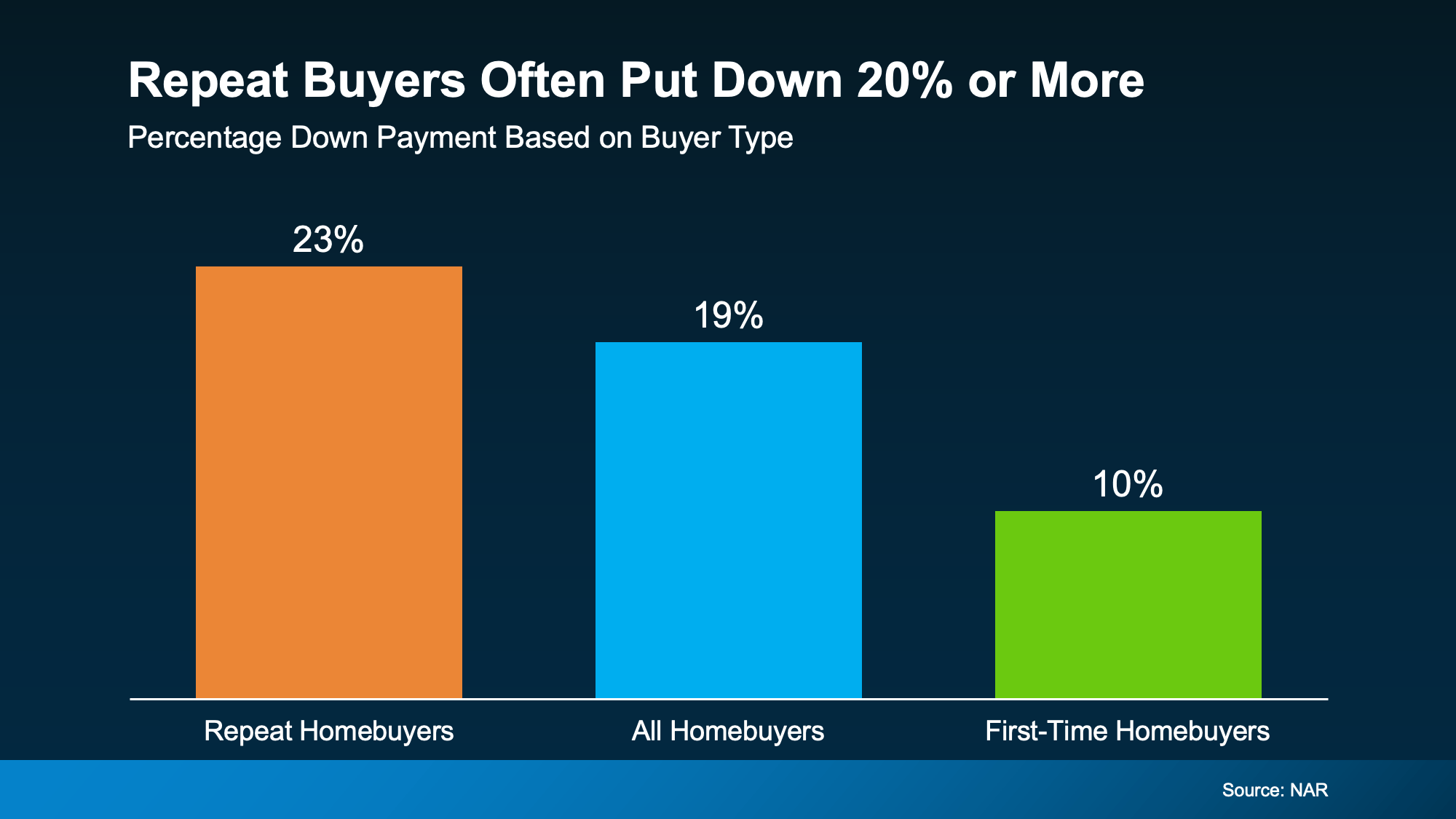
That is significantly higher than the typical down payment made by first-time buyers.
Why the difference?
For many repeat buyers, the answer comes down to one word: equity.
If you’ve owned your current home for several years, you may have gradually built a substantial amount of equity. That equity can come from two sources.
First, you’ve likely been paying down your mortgage balance over time.
Second, your home may have increased in value.
The combination can be powerful.
For example, imagine you purchased a home years ago for $300,000. Over time, you paid down your mortgage while the property’s market value increased. If the home is now worth considerably more than what you owe, the difference represents your home equity.
That equity isn’t just a number on paper.
When you sell, it can potentially become cash that you can use toward your next home purchase.
Your Home Equity Could Be Your Next Down Payment
This is where the situation gets interesting for homeowners considering a move.
First-time buyers typically have to build their down payment from savings, investments, gifts, or other sources.
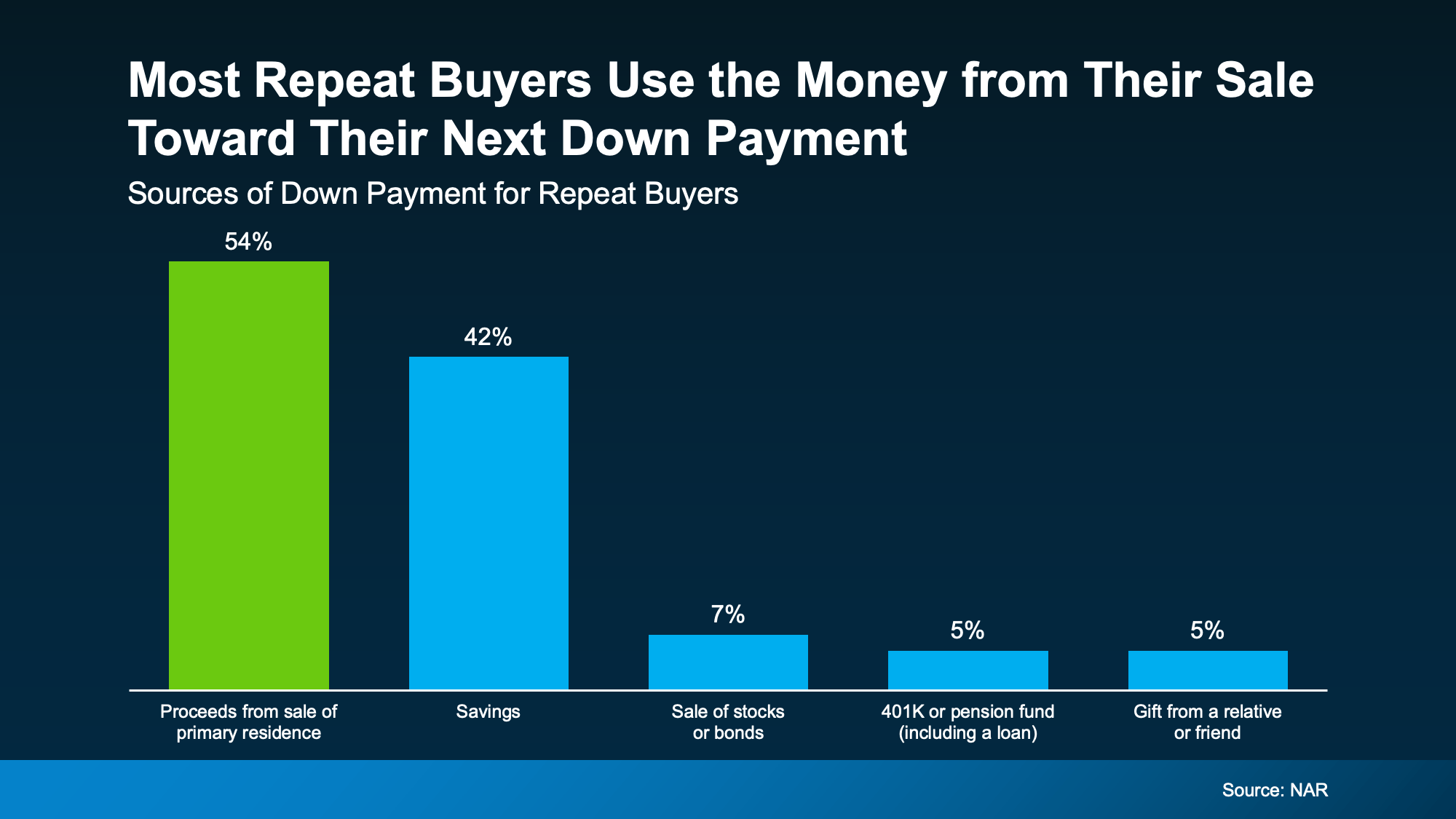
Repeat buyers may have another option sitting right in front of them—their current home.
Selling your existing property can unlock the equity you’ve accumulated. After accounting for the remaining mortgage balance and selling expenses, the proceeds may give you a much larger down payment for your next house.
In other words, the home you’re leaving could help finance the home you’re moving into.
That’s one reason repeat buyers may be in a stronger position to put 20% or more down.
Of course, every homeowner’s equity position is different. Your actual proceeds will depend on factors such as your home’s current market value, remaining mortgage balance, selling costs, and other expenses.
That’s why it’s important to look at your specific numbers rather than relying on a general rule.
Why Put 20% Down on a House?
If you can comfortably afford a 20% down payment without draining your savings, there are several potential advantages worth considering.
A larger down payment doesn’t automatically make a purchase better. But it can improve the financial picture in several ways.
1. You Could Have a Lower Monthly Mortgage Payment
The basic math is simple.
The more money you put toward the purchase upfront, the less you need to borrow.
Suppose you’re purchasing a $500,000 home. A 10% down payment would mean putting $50,000 down and financing the remaining $450,000.
A 20% down payment would put $100,000 down, leaving you with a $400,000 mortgage.
That’s a $50,000 difference in the amount borrowed.
With mortgage rates still an important consideration for buyers, reducing the size of your loan can help lower your monthly principal-and-interest payment.
And when you’re already balancing property taxes, homeowners insurance, maintenance, utilities, and everyday expenses, every reduction can matter.
2. You May Pay Less Mortgage Interest Over Time
A smaller mortgage balance doesn’t just affect your monthly payment.
It can also reduce the total amount of interest you pay over the life of the loan.
Think about it this way: your lender charges interest based on the amount you borrow. If you borrow less, there’s simply less principal for interest to accumulate against.
That doesn’t mean putting 20% down is always the best financial decision. If using that additional cash would leave you without an adequate emergency fund or prevent you from handling other important financial goals, keeping more money available may be wiser.
But if you have enough financial reserves and can comfortably make the larger down payment, reducing your mortgage balance can potentially save you money over time.
3. You Can Typically Avoid PMI on a Conventional Mortgage
Another potential advantage of reaching the 20% threshold is avoiding private mortgage insurance, or PMI, on a conventional mortgage.
When a buyer puts less than 20% down on many conventional loans, the lender may require PMI. This insurance protects the lender—not the homeowner—and it can add another expense to your monthly housing costs.
Putting 20% down can eliminate that requirement in many conventional loan scenarios.
That means more of your monthly payment can go toward your mortgage rather than an additional insurance cost.
However, mortgage rules vary, so it’s important to ask your lender exactly how PMI applies to your loan.
4. A Larger Down Payment Can Strengthen Your Offer
Buying a home isn’t just about finding a property you love.
You also need the seller to choose your offer.
When multiple buyers are competing for the same property, the strength and reliability of the financing can matter. A larger down payment may signal to a seller that you have substantial funds invested in the transaction and potentially a stronger financial position.
Does that guarantee your offer will win?
Absolutely not.
Price, contingencies, closing timeline, financing terms, and other factors can all influence a seller’s decision.
Still, when everything else is relatively equal, a strong down payment can give your offer another advantage.
Should You Put More Than 20% Down?
If 20% can be beneficial, does that mean you should put down 25%, 30%, or even more?
Not necessarily.
There’s a point where putting additional money into the house may provide diminishing benefits compared with keeping that money accessible elsewhere.
Your down payment is only one part of your overall financial picture.
Before putting a large portion of your savings into a home, consider whether you’ll still have enough money for emergencies, moving expenses, repairs, renovations, closing costs, and other financial priorities.
Remember, a beautiful new home won’t feel quite as comfortable if buying it leaves your bank account gasping for air.
The goal isn’t simply to put as much money down as possible.
The goal is to find the down payment strategy that fits your financial situation.
How Home Equity Can Make Your Next Move Easier
For repeat homeowners, the biggest question may not be, “Can I save 20%?”
It might be, “How much equity could I bring to my next purchase?”
That’s an entirely different question.
If your current home has appreciated significantly and you’ve reduced your mortgage balance over the years, you could have meaningful equity available.
That could potentially help you:
- Make a larger down payment
- Reduce your new mortgage balance
- Lower your monthly payment
- Avoid PMI on a conventional loan
- Potentially reduce long-term interest costs
- Make your offer more competitive
Of course, selling a home involves costs, and your entire equity balance won’t necessarily become available as cash for your next purchase.
That’s why understanding your estimated home value and remaining mortgage balance is an important first step.
Don’t Let the 20% Rule Make the Decision for You
The idea that every buyer must put 20% down is outdated.
For some buyers, putting 5%, 10%, or another amount down may be the smarter choice. For others—particularly repeat homeowners with substantial equity—20% or more could make financial sense.
There is no magic number that works for everyone.
Instead, look at the entire picture.
How much is your current home worth? How much do you still owe? What would your estimated selling costs look like? How much cash would you have left after the sale? What mortgage payment would you be comfortable carrying? And how much should you keep in savings after closing?
Those questions are much more useful than simply asking whether you’ve reached 20%.
The Bottom Line: Your Equity Could Be Your Biggest Advantage
You don’t have to put 20% down to buy your next home.
But if you’re a repeat buyer who has built significant equity, you may have an opportunity that wasn’t available when you purchased your first home.
A larger down payment could help reduce your mortgage balance, lower your monthly payment, potentially eliminate PMI, reduce long-term interest costs, and strengthen your offer.
The key is making the decision based on your numbers—not an old rule.
If you’re considering selling your current home and buying another, start by finding out what your home may be worth and how much equity you could potentially put toward your next purchase.
Your current home may be more than the place you live.
It could be the key to making your next move possible.
Recent Posts







GET MORE INFORMATION