The Kind of House Buyers Are Willing to Pay More For

That spare bedroom on the main floor. The finished basement with a kitchenette and private entrance. The bonus room you’ve been using to store boxes.
You may simply see them as extra space. But for a growing number of homebuyers, those features can be exactly what makes your property stand out—and potentially makes them willing to pay more.
Why? Multigenerational living is becoming increasingly common.
As families look for ways to live together while maintaining some privacy and independence, homes designed to accommodate multiple generations are attracting serious attention. If your house has the right layout and features, you may have something today’s buyers are actively searching for.
Multigenerational Homes Are Becoming More Popular
A multigenerational household generally includes three or more generations living under the same roof. Think parents, adult children, and grandparents sharing one home.
According to Realtor.com, the number of multigenerational households in the U.S. grew from about 3.2 million to nearly 4 million between 2014 and 2024.
That is a significant increase—and it reflects a broader shift in how families think about housing.
Why are more families choosing to live together?
For some, it’s about affordability. Combining household expenses can make homeownership more manageable in a market where housing costs remain a major concern. For others, it’s about convenience, caregiving, or simply wanting family members nearby.
And then there are families who want the best of both worlds: togetherness without giving up personal space.
That’s where the right home layout becomes especially valuable.
What Makes a Home Multigenerational-Friendly?
Not every large house is automatically a multigenerational home.
Square footage matters, but functionality matters just as much. Buyers may be looking for spaces that allow different generations to live together comfortably without constantly getting in each other’s way.
Features that can make a home especially attractive include:
- A main-level bedroom and bathroom
- A private in-law suite
- A finished basement
- A second kitchen or kitchenette
- Separate entrances
- Multiple living areas
- Additional bedrooms
- Flexible bonus rooms
- Private bathrooms
- Accessible layouts for older family members
Think of the home like a Swiss Army knife. The more practical ways it can serve a family, the more valuable it can become to the right buyer.
A finished basement, for example, might be a game room to one buyer. To another, it could be a comfortable living space for an aging parent or an adult child who wants more independence.
The feature itself is important—but how buyers can use it is what creates the appeal.
Location Can Make the Demand Even Stronger
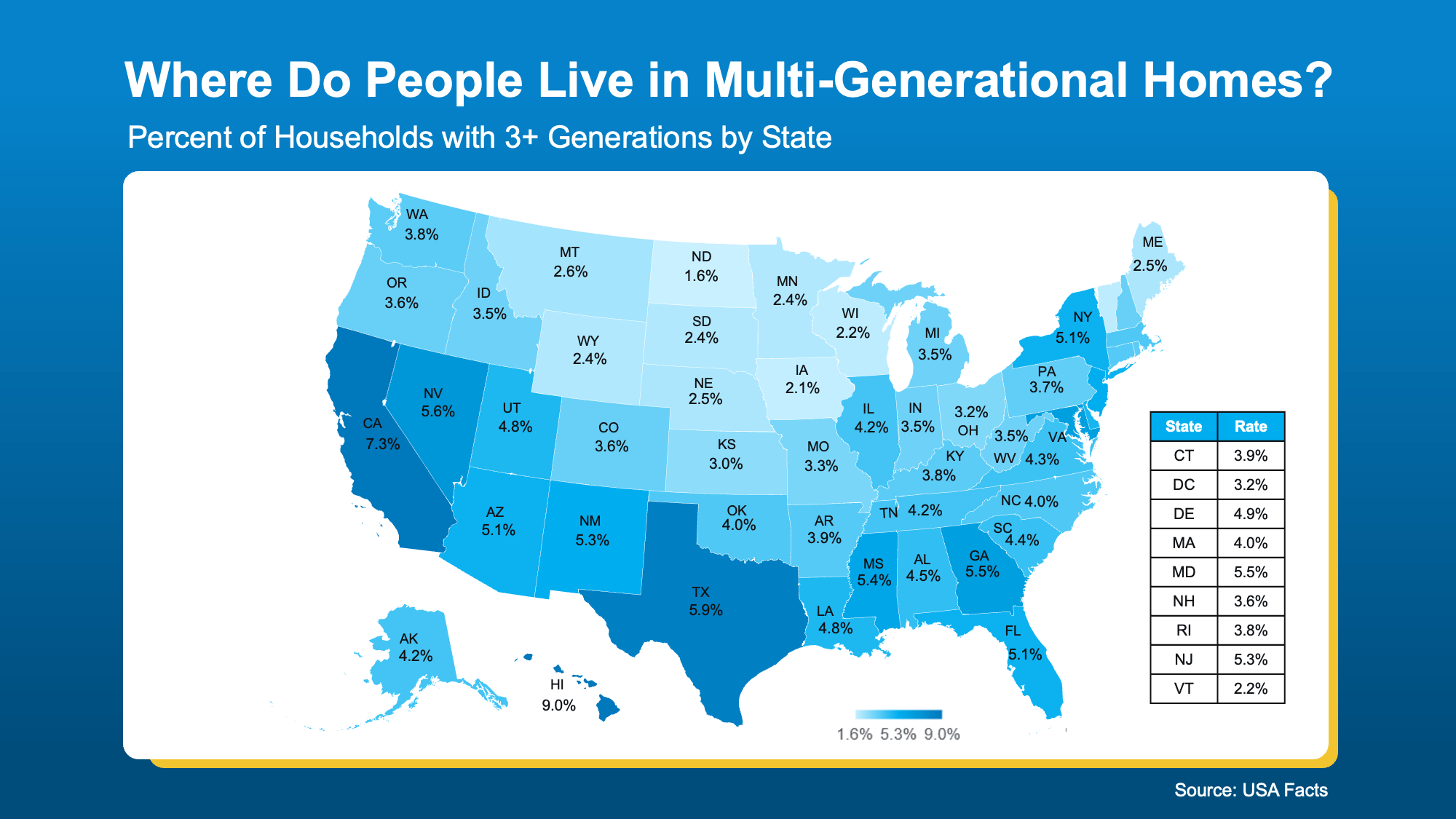
Multigenerational living isn't equally common everywhere.
USAFacts data shows that the prevalence of multigenerational households varies significantly from state to state. That means the potential buyer pool for a home with multigenerational features can depend heavily on your local market.
This is important if you're thinking about selling.
Your home doesn't have to appeal to every buyer. It needs to appeal strongly to the buyers who are most likely to value what it offers.
If multigenerational households are particularly common in your area, a home with multiple living spaces, separate entrances, or an in-law suite could have an advantage over a conventional property with a similar amount of space.
In other words, the right feature in the right market can be worth more than its size suggests.
Multigenerational Homes Can Command a Premium
Here’s where things get particularly interesting for homeowners considering a sale.
Realtor.com reported that the median asking price for a multigenerational home was approximately $709,000 in 2025, compared with about $429,900 for a standard home.
At first glance, some of that difference can be explained by size. Larger homes naturally tend to cost more.
But the comparison becomes more interesting when looking at price per square foot.
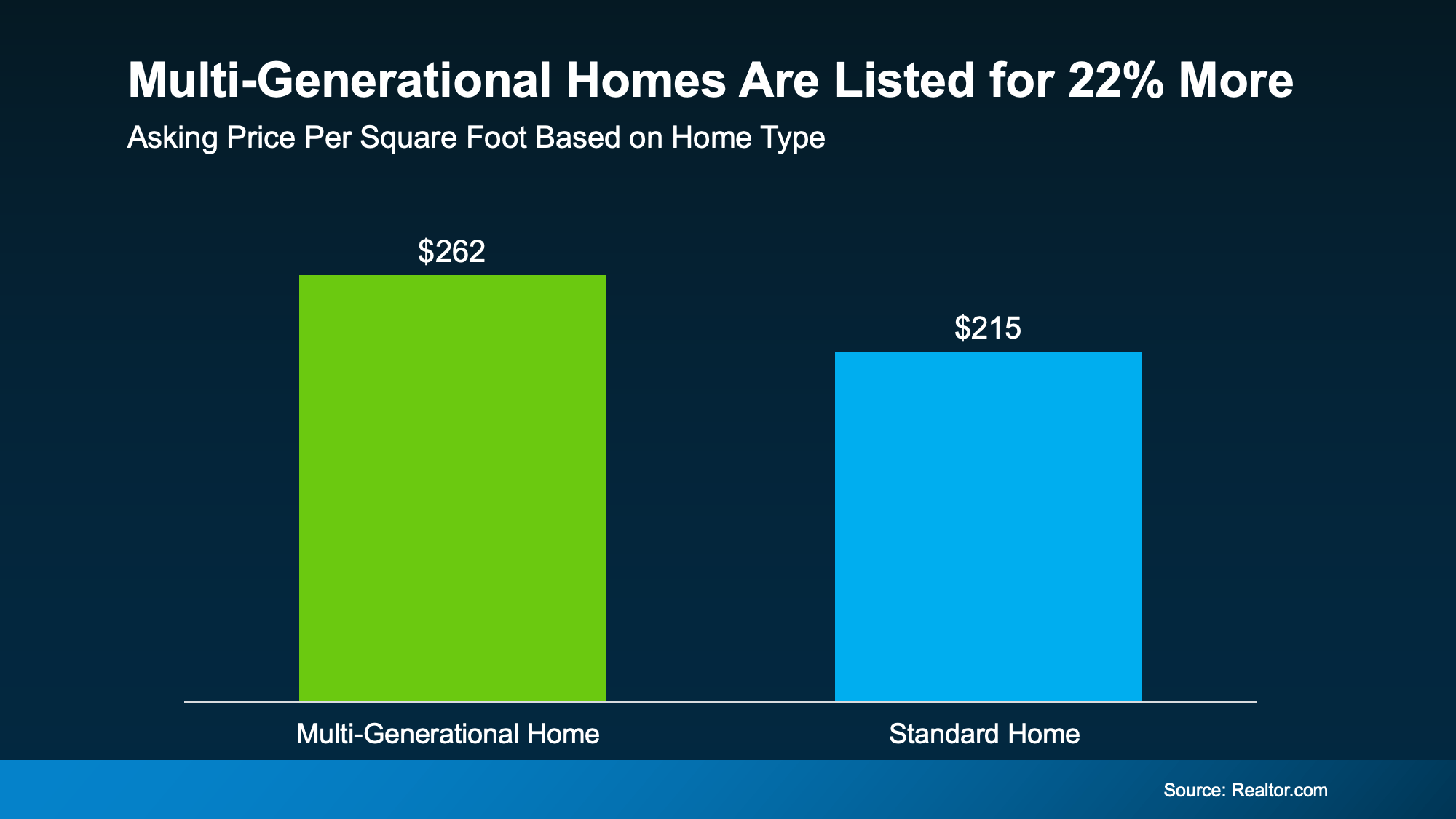
Multigenerational homes were reported at roughly $262 per square foot, compared with approximately $215 per square foot for standard homes.
That's about a 22% premium per square foot.
Because they're not necessarily buying more square footage. They're buying functionality.
A second kitchen can provide independence. A separate entrance can create privacy. A main-level bedroom can make a home more practical for an older family member. A finished lower level can effectively create another living zone.
These features solve real problems.
And when a house solves a problem that several buyers are actively trying to solve, its value can rise.
Buyers Are Paying Attention to These Homes
Higher prices don't appear to be stopping buyers from looking.
According to the same Realtor.com report, multigenerational homes received 13.5% more online views than standard homes and still sold in roughly 59 days.
That's an important signal.
More online attention means more potential buyers are stopping to look. And when a home continues to sell at a competitive pace despite carrying a higher price tag, it suggests buyers see enough value to justify the premium.
As Realtor.com Senior Economic Research Analyst Hannah Jones noted, strong demand combined with limited inventory can create a significant advantage for sellers whose homes meet a specific need.
And that is really the story here.
Specificity can be powerful in real estate.
A house designed for everyone may blend into the crowd. A house that solves a very particular problem can make the right buyer stop scrolling.
Don't Hide Your Home's Most Valuable Features
If you're preparing to sell a multigenerational-friendly home, don't assume buyers will automatically recognize the value of its layout.
Real estate marketing is a little like storytelling. You can have a great story, but if you bury the best part, your audience may never notice it.
Instead of simply saying:
“Finished basement.”
Show buyers what that space can do:
“Finished basement with kitchenette, full bath, and private entrance—ideal for extended family or independent living.”
Instead of:
“Main-floor bedroom.”
Consider highlighting:
“Convenient main-level bedroom and bath, offering flexible living for guests or older family members.”
The goal isn't to exaggerate or make promises. It's to help buyers visualize how the home could fit their lives.
Because buyers don't just purchase rooms.
They purchase possibilities.
The Right Buyer May See More Value Than You Do
Here's something homeowners sometimes overlook: you live in your house every day, so you may stop noticing what makes it special.
That extra room becomes “the storage room.”
The basement becomes “where we keep everything.”
The second entrance becomes “the door nobody uses.”
But a buyer searching for a multigenerational home could see something completely different.
They may see a private apartment for Mom and Dad.
They may see a comfortable space for an adult child returning home.
They may see a way to keep grandparents close while preserving everyone's independence.
They may see a solution to a housing challenge they've been trying to solve for months.
That's why understanding your home's buyer appeal matters before putting it on the market.
How to Position a Multigenerational Home for Sale
If your home has features that support multigenerational living, make sure your pricing and marketing strategy reflect them.
Start by identifying the features that genuinely differentiate your property. Then consider how those features compare with similar homes currently available in your market.
Your agent can help determine whether buyers in your area are actively searching for properties with in-law suites, separate living quarters, additional kitchens, finished basements, or other flexible spaces.
From there, the marketing should make those benefits easy to understand.
Professional photography, thoughtful listing descriptions, floor plans, and targeted messaging can all help buyers recognize the possibilities your home offers.
The key is not simply to say that your house is bigger.
Show why the extra space matters.
Bottom Line
Your larger-than-average or multigenerational-friendly home may have something many buyers are struggling to find: space that works for more than one generation.
As more families consider living together, homes with flexible layouts, private living areas, additional kitchens, separate entrances, and accessible spaces can stand out from traditional properties.
And when demand is strong for a specific type of home, the right features can translate into real value.
So, before you dismiss that basement, spare bedroom, or bonus room as “just extra space,” take another look.
It may be one of the reasons a buyer is willing to pay more.
Thinking about selling? Let's take a closer look at your home's features, your local market, and what buyers may be willing to pay for a property like yours.
Recent Posts






GET MORE INFORMATION